Sunday, December 5, 2010

moo-ing

I just wrapped up my web 2.0 reflection on my tech portfolio website, and it got me reminiscing about the ancient future of internet facilitated discourse, the MOO. A MOO is an multi-user, object oriented virtual space. I actually built an educational MOO as my senior project in college, called MOO-tropolis. I interned with an intellectual historian who was certain that electronically mediated communication would enable us to remake our very identity.

People connected from around the word to interact in these text-based environments. Many MOOs existed purely for entertainment, but others had higher aims, such as facilitating intellectual discourse (Postmodern Culture MOO) or revolutionizing the way we thought of classrooms (Diversity University). What's most intriguing about these environments nowadays is that a) no one has ever heard of them, and b) the way we approach education is mostly not revolutionized by their once-upon-a-time prevalence. This makes me think twice when I hear something claim it's going to change everything.


PMC MOO screenshot


I use, like, and benefit from modern technology, the internet, and "web 2.0" technologies, but I like to maintain proper perspective, too.

Tuesday, November 30, 2010

the khan academy

The Khan Academy bills itself as "The free classroom for the world." This useful website has video lessons and interactive exercises galore - math is highlighted, but there are lots of lessons in other disciplines (science, economics, history...) and they range from introductory to advanced. Take a look at this PBS NewsHour feature, then then go check it out yourself!


I tried out a few of the interactive math exercises - addition and multiplication. There's a helpful map on the first screen that organizes the math exercises, so students can see the progression of math concepts and select the appropriate exercise. The math exercises I investigated were all drills, so they would mainly be useful for children who just needed to bone up on their math facts. It could be that other exercises are more sophisticated, but I haven't delved deeply into the exercises section. Of course, those kids with comprehension problems can take a look at the lessons, too.

The main drawback of this site is that it requires a computer with internet access to utilize. While we assume that everyone is wired in this day and age, I have found that a lot of kids in my main placement school face significant challenges gaining access to computers. For your kids who do have computers, I'd recommend taking a look at this helpful site.

Monday, November 22, 2010

chunking

While we're having a great time with our second grade buddy, Lisa*, Susan's and my session with her didn't go as smoothly as it could have last week. Our buddy just doesn't seem to enjoy reading. She likes books, loves talking about books, and clearly enjoys being read to. However, when reading a book herself, she frustrates easily and doesn't make sustained attempts at decoding unknown words. After a sentence or two, she's ready to move on to something else and has an arsenal full of diversionary tactics waiting to be deployed. As a result of this, our attempt to do a running record with her wasn't successful -- even though we had selected easier books for our session than the ones we looked at the week prior. Lisa was still struggling or still reticent to read, or a little of both.

On more than a few occasions, when encouraged, Lisa would try chunking the words she didn't know. She wasn't always successful, even with words that seemed particularly amenable to a chunking strategy, like compound words. Reading Fox, and looking back at a specific instance where Lisa was trying to decode by chunking, I think I might see why she was unsuccessful. On one occasion, she wanted to decode a word by chunking it, and wanted Susan to cover one portion while she decoded the other. I can't recall the exact word, but her strategy progressed along the lines of taking a word such as "nothing" and trying to chunk it into "not" and "hing" or "no" and "hing," ignoring the "t". (Susan, if you're still reading my blog, correct me in the comments!) Fox said something that seems to make sense of what was going on here.

Fox (2008) states that using "the multiletter strategy hinges on identifying chunks" in words (p. 180). However, when using this strategy, readers have to know which letters form viable chunks and which do not. Readers, Fox tells us, "use their knowledge of letter-sound patterns to determine the letters in new words that are most likely to belong in groups" (p. 180). This is a skill that must be practiced. I had a bit of an "aha moment" when I read this, because it seemed to identify why Lisa was struggling when attempting a chunking strategy. Either she has not had enough practice honing her chunking skills, or she hasn't yet mastered letter-sound and analogy strategies.

I am curious whether Lisa receives extra reading help. It's clear she's been taught strategies to help her decode new words, and while she both tried and experienced a level of success with of some of these strategies during our time together, her stamina is low. I am not sure if offering an even easier book to read will spark a desire to read more, but I'm hoping so, and will try some easier books when we meet tomorrow.

*pseudonym

Monday, November 15, 2010

darius goes west

I've been hearing a lot about the documentary Darius Goes West lately, a documentary about a young man with Duchenne's Muscular Dystrophy named Darius Weems. This film has been highly recommended (by Oprah, for instance) for use in middle to high school classrooms - to both raise awareness about the disease (which is the number one genetic killer of youth worldwide) and to "propel the positive & empowering message of Darius Goes West as far and as wide as possible." (from dariusgoeswest.org) To achieve this goal, The Darius Goes West website will ship out a free DVD to educators and has made available a "standards based curriculum" to accompany the film. Arrangements can also be made for Darius Weems to attend a video-conference Q&A in your classroom.

Admittedly, I hadn't given a lot of additional thought to what I'd heard about Darius Goes West - for one thing, if I land in middle school, I'll be teaching middle level science (although an interdisciplinary approach that investigated the cause of Duchenne's, research like gene mapping, treatments, and potential cures could be very interesting). However, while channel surfing the other night, there it was, being shown on the Halogen channel. I decided to watch it, and it was a very touching movie about a 15 year old young man who knew his life would be cut short (his brother died as a result of Duchenne's at 19) and wanted only to go west and get his wheelchair "pimped" on MTV's "Pimp my Ride." It definitely evoked sympathy for Darius (especially since MTV wouldn't touch his wheelchair or invite him on the show) and inspired you to also pay attention to issues of inclusion and difference. Of course, it also encouraged you to support Duchenne's research. Overall, I thought that the documentary was good.

As I watched, though, thoughts expressed in one of the readings from our special needs class kept springing to mind. I can't recall the title of that article, but it contained a section decrying the "poster child" method of raising awareness of (and funds for) diseases and/or disabilities. One danger, we were told, is that the emphasis becomes the generation of revenue, with the poster child simply shilling for disease research. A good treatment of this issue can be found in another article, "From Poster Child to Protestor". Author Laura Hershey's particular beef is with the Jerry Lewis telethon, and she expresses the following complaint about manufacturing poster children:
    Now we were taking on one of the biggest barriers of all: the paternalistic attitudes which prevail in our society, and which are reflected so dramatically in the annual telethon.
So, for anyone reading this blog, I toss the ball into your court. What do you think about this? Is finding a charismatic, sympathetic character and casting him or her into the role of "Poster Child" good, mostly good, tending to do more harm than good, or just wrong? Let me know what you think. And do watch Darius Goes West if you get the chance.

Saturday, November 6, 2010

the zombie zapped the zebra's head

One of activities we chose for our kindergarten buddy was Silly Sentences, found in chapter four of Fox's Word Identification Strategies. When we administered the emergent literacy profile to our buddy, there was some confusion around the beginning sounds section. When we asked him to identify the beginning sounds of the listed words, he named the beginning letters rather than the sounds. For example, when given the word "more" and asked "What sound does more begin with?," he answered "m". He even offered the letters "c-h" instead of naming the beginning sound for the word children.

Given his responses, we thought that Silly Sentences exercise could help reinforce the concept of beginning sounds. We came up with a half dozen or so silly sentences, crafted with his interests in mind - like many meerkats munch on millipedes - and wrote them on index cards. We had our buddy read each card and identify the common beginning sound. He caught on quickly and enjoyed the exercise, which also included illustrating each silly sentence. After we went through the prepared cards, we encouraged him to craft his own silly sentences on blank cards. This is when he really showed us that he "got it." One of his silly sentences was "The zombie zapped the zebra's head." Wow!

Another strategy identified by Fox that really struck me was that of using rimes to sidestep exceptions. For example, in a short word with one vowel followed by a consonant, the vowel is usually short. We can teach it this way and then start addressing all the exceptions, one of which is the word "find." Fox points out that given the vowel/consonant rule, the i in find should be pronounced like the i in dish, but isn't. It certainly seems like this could be a point of serious confusion for kids, hence Fox's assertion that teaching rimes is preferable. It seems much clearer to teach a child that -ind makes the sound found in find, kind, and rind and that -ish makes the sound found in dish, wish, and fish. I really liked this strategy and the way Fox described it.

I'm a little sad our time with our kindergarten buddy is at an end for now, but I'm excited to meet our second grade buddy next week.

PS Please think twice about using plastic baggies for the "Baggie Book" activity on page 165. There has to be another way to accomplish the desired effect without using a large quantity of environmentally un-friendly ziploc plastic bags. It's just wasteful.

Monday, November 1, 2010

curriki

Curriki, a play on the words 'curriculum' and 'wiki', is a not-for-profit organization that is building the first and only Internet site for Open Source Curriculum (OSC), which will provide universal access to free curricula and instructional materials for grades K-12. - Curriki's About Us Section

I recently received an email about Curriki -- we all know what wikis are now, and Curriki operates on the same principle as our cohort wiki, but is specifically for curriculum development. With Texas loudly exerting its political will by demanding changes such the removal of a so-called "pro-Islamic" slant from textbooks -- and the sheer size of their textbook order means that what Texas asks for is what we all get -- an "open source" alternative is like a breath of fresh air. Curriki states a goal of a "complete curricula solution." You can search for lesson plans and units, revise them, upload your own stuff, join a project, find a teacher to collaborate with, or read their blog. When you sign on for this endeavor, its best to leave your increasingly obsolete (for better or worse) notion of intellectual property at the doorstep. Curriki embodies what we know and have learned about web 2.0. It's an interactive virtual educational community built around resource sharing, content building, and meaning making. Pretty cool.

Curriki has an excellent guided tour of their site. Check it out and let me know what you think of this idea!

The Curriki Blog's Wordle -- the collaborative vision of Curriki
Never heard of a Wordle? They're pretty neat creations, take a look! Try Wall Wisher, too, while you're at it...

Sunday, October 24, 2010

writer's workshop

Coincidental to this week's assigned readings -- chapters 1-3 of Regie Routman's Writing Essentials -- I received an e-newsletter from Edutopia (is it clear by now that I love this site? ;)) about the writer's workshop as an excellent tool for differentiation. Similar lines of thinking are pursued in both Routman and in the Edutopia article, titled The Writing Workshop: A Valuable Tool for Differentiation and Formative Assessment. The author of the Edutopia article, Todd Finley, states that we need to get students past a fear of not writing correctly and to instead write from a place where right and wrong aren't the ultimate criteria. Like Routman, Finley asserts the need for students to experience false starts, make mistakes, collaborate, and adjust. Both authors see good writing as the result of this process, which doesn't start and end with skills formation.

The writer's workshop is used in my own main placement classroom. The ideas contained in Routman's first three chapters -- about simplifying the teaching of writing, celebrating student writing, and showing students your own writing life, respectively -- were all clearly modeled by my master teacher. As I was reading Routman's ideas, I found that for most of them I could point directly to an example in my main placement classroom. Writing small moments? We did that. Modeling the writing process for students on the overhead? My teacher did that, too. Open sharing? Celebration of writing? De-emphasizing "skills" like spelling everything right the first go? Yes, yes, and yes. So far, I like the writer's workshop and see it as a great tool for inspiring our kids to view themselves as writers and enjoy writing.

My nascent understanding of the writer's workshop leads me to believe that differentiation should more or less naturally happen -- it seems inherent to the model. To an extent, that is what I see in my 4th grade classroom. Everyone's writing at their own level, and everyone has both their own strengths and areas they could work more on. However, I am also noticing some kids shutting themselves out of the process entirely. One boy, in particular, didn't write more than a few lines in his writer's notebook the entire four weeks I was there. I know, as Routman says, that for some kids simply getting down a title is an achievement. We've celebrated that for this boy. No technique seems to help this boy see himself as a writer, though. He's so set against the notion of writing that sometimes he literally rolled around on the floor to avoid it. I'm very curious to see what he's doing -- whether he's writing more, less, or the same amount -- when I return in January. If he's blossomed, I'll definitely want the low down on what my master teacher found to inspire him.

Friday, October 22, 2010

rappin' math

I've been enjoying our math articles these past few weeks. They've been giving me great food for thought about mathematizing and approaching math in new ways. I recently received a e-newsletter from Edutopia about math in the classroom, which included information about writing your own math raps. I enjoyed the rap they posted, PEMDAS Boss by Rappin' Mathematician Alex Kajitani, so much that I thought I'd share another one with those of you who follow my blog. This one's called The Number Line Dance. Enjoy!


I don't know if I have what it takes to be a rap master of math, but I'm willing to consider it (or at least use the Rappin' Mathematicians CD ;)). If you want to take a look at the Edutopia resource, visit How to Write Your Own Math Rap. While you're there, look around. Edutopia has tons of fantastic resources!

Saturday, October 16, 2010

fun with phonemes

Last week we had our first literacy class in the elementary school we'll be working at for the rest of the quarter. My cohortmate, Amelia, and I met our kindergarten reading buddy, Nathan*. What a fantastic little boy Nathan is! I was quite astounded by Nathan. We had great fun filling out our "getting to know one another" questionnaire. Once we got started on it, Nathan insisted on writing down everyone's answers all by himself. I was quite impressed with his thoughtful concentration and ability to spell out words phonetically. I didn't realize until yesterday, when I read Fox's chapters on phonemic and phonological awareness in her book Word Identification Strategies, that we were being wise when we let him try to spell out words phonetically. Apparently, this exercise built up his phonemic awareness as he tried to identify the sounds he heard in the words and write them down. This seems a particular skill of Nathan's, as he came very close to correctly spelling a lot of the words he was recording for us.

His ability to identify sounds in words became even more apparent when it was time for us to read him our book selections. Nathan turned the tables and insisted on reading to us! My book selection, The Very Busy Spider, had some words in it that were pretty sophisticated for a kindergartner, and so did Amelia's. However, I can't recall more than a few words that Nathan couldn't manage to sound out correctly on his own. He also recognized word patterns in the book, such as phrases that regularly repeated and he surprised me when, a few pages into his reading, he announced the connection between The Very Busy Spider and another book, The Very Hungry Caterpillar - both were written by the same author. I was quite impressed with Nathan. As precocious as he is, he will need to allow us to read to him in the future, in order to practice his comprehension skills. Although he could sound out words, he didn't always understand them and he wasn't really reflective in his reading because he was too focused on sounding out the words correctly. I am not sure how well he could have summarized or re-told the stories he read to us.

In all, I think it's going to be an absolute pleasure working with Nathan (and with Amelia, too!). It's clear his kindergarten teacher has done an excellent job promoting literacy in her classroom. Literacy was highlighted in many ways that spoke to its importance, such as the alphabet charts on desks and on the walls, a lite brite for spelling out words, and signs and sight words posted throughout the room. I'm excited for next week.

*name changed to protect privacy

Monday, October 11, 2010

reader's workshop

As I read the article Emergent Literacy: New Perspectives by Teale and Sulzby, I found myself noting parallels to the "Reader's Workshop" model that was implemented at my main placement school this year. Although the techniques in the article were generally prescribed for early childhood education programs, some of them were familiar to me as components of the "Reader's Workshop." One important aspect of the workshop is to clearly model a reading life for the kids. As teachers, we're encouraged to keep reading diaries right alongside the kids - noting books we've read, are reading, and want to read. This strategy is promoted to ensure that kids become aware of you as a reader with a reading life, and to let them see you reading and enjoying books. This sort of modeling is what came to my mind when Teale and Sulzby described the importance of encountering literacy at home, through having books around the house, through read aloud experiences, through seeing their family members engaged in reading activities, and through learning about and helping to construct shopping lists, to name a handful of ways in which literacy can be encouraged.

It appears to me that the backbone of the "Reader's Workshop" is a largely a continuation of some of the strategies described by our reading that encourage emergent literacy. I believe this approach will prove useful for developing strong readers, especially since many of the kids may not have, or have ever had, rich literacy experiences at home, nor may they have had beneficial early childhood experiences with literacy. I am interested to see how the workshop progresses over the year and whether it will engage the children effectively or prove beneficial, especially to some of our struggling readers. I believe the workshop's potential benefit will be enhanced by it's advice to have a wide variety of reading materials available in the classroom, dealing with diverse topics and at different reading levels, so kids can have books available that appeal to and are accessible to them. This may seem too common sense to mention, but it might be easy to overlook a genre that doesn't appeal to us when building classroom libraries. Also, kids need books with characters that look like them and reflect their own experiences.

Reading aloud seems another important component of the workshop, in the same way and for many of the same reasons given in Teale and Sulzby's article. I've noted most, if not all, of the read aloud strategies described by Teale and Sulzby implemented in my classroom, such as making predictions, drawing inferences, and examining vocabulary. However, I haven't really noticed that reading aloud to the kids is encouraging them to widen their reading horizons or to select books they may have otherwise passed over. Perhaps it's still too soon in the year for me to observe the benefits of reading aloud described by Ivey in her article The Intermediate Grades. Maybe the book we were reading last month just didn't grab them, or it could be that they were doing a lot of internal processing that wasn't apparent to me. At any rate, I am intrigued by the "Reader's Workshop" - and am interested to see how it unfolds over the year. My one concern is that I don't have a good feel for how scripted the curriculum is, and hope there is room to incorporate reading for other subjects, such as science and social studies. We'll see!

Friday, October 1, 2010

what teachers make

If you haven't checked this out, do. Awesome.


Thursday, June 3, 2010

reflecting on the quarter

As I look back through the quarter, I’ve found that I’ve both reaffirmed some thoughts about teaching that I came into the class with and have had to reevaluate others. Probably one of the most important insights I gained was fully realizing something I’d only suspected: that, as I wrote earlier in my blog, “we cannot expect the answers to our questions about education to come to us as Platonic forms or Golden Rules that will magically transform education into an incorruptible ideal.” As I further stated: “Our answers will alternately be brilliant and bad - both messy and mutable.” I feel these to be two of the most valuable insights I received because these realizations, that none of our ideas, insights, or techniques will be the magic bullet that solves the problem of how best to teach forever, are, in my opinion, critical for teachers to come to.

This realization is both my hope and my fear. I say hope because it’s simply a wonderful thing to believe that the role of a teacher will never be perfected or statically defined, that there will always be change and growth and learning and new adventures on my journey as a teacher. I say fear because I now realize that the role of a teacher will never be perfected or perfectly defined, and that though I may crave direction, there is no best way or formula that will enable me to get it right every time. Such a formula simply cannot exist. A formulaic approach would only be possible if the classroom and its complement of students fit some scientifically controlled standard - but, thanks to Heraclitus, we all know that the only constant we can expect is change, that we can never step into the same river twice. All systems evolve, and teaching doesn’t occur in a vacuum. While this open ended question of how best to teach terrifies me - I often worry about how badly I can mess up, especially starting out - it’s also an exhilarating prospect. To me, it’s what going to keep teaching interesting.

Everything that I wrote after this initial realization reflects this idea. Most of the inspiring ideas I took from Ayers and other authors’ writings this term were all rough outlines, guidelines, suggestions, and queries - not prescriptions. The hard part is going to be how to know what something feels like without first being able to see it or touch it. Jane asked me several times in response to my earlier blog posts what certain things would look like, and that’s just a difficult question for me to answer, especially right now. My ignorance of how things will actually work feels a bit justified, however, as this term feels like the part of the certification program where I am permitted to theorize and conjecture to my heart’s content. The ability to feel ideas out and limn what certain things might look like in the classroom will come as we progress through the program, or at least I certainly hope it does!

Another conclusion I came to this semester is that I am a very “left” thinker regarding education. Although I still have proclivities that reflect more conservative thought - such as an affinity for concrete assessments and valuations of my work - for the most part I could sit down to dinner with folks like John Dewey, Neil Postman, William Ayers, Lisa Delpit, Vivian Paley, Maxine Green, Margret Buchman, et al. and just thrill to all the ideas and theories they could share with little disagreement. I can’t wait to try out ideas like Delpit’s and Greene’s that aim for understanding and appreciating difference, for using the arts and storytelling. I’m excited to investigate how best to create a caring classroom community and to practice “seeing” my students. I look forward to creating relevant curricula and developing authentic alternative assessments, and exploring project based, interdisciplinary, and experiential learning.

But is this going to happen? I’m beginning to have a few doubts. No Child Left Behind shackled schools to standardized testing and enslaved teachers to curricula which pursued one goal: higher test scores. Now Race to the Top (aka Dash for the Cash) seems to promise more of the same and new standards based accountability for teachers. Where is project-based learning going to fit into this? Where is a spirit of valuing strengths over identifying deficiencies going to find a foothold? I visited a potential main placement school with Jon Howeiler and several of my cohort members a couple of weeks ago. The principal mentioned the “Balanced Literacy” program nearly a half a dozen times in as many minutes. I’m certainly not against the aims of the “Balanced Literacy” program, but I do feel put off by the constraints such a rigid methodology puts on teachers, and I do not like the short shrift it gives to content. Is this really the only recourse for getting those coveted test scores? Is it really balanced literacy if the students can pass a standardized assessment but cannot intelligently evaluate a piece of writing? Further, can any other methodology find a place in a school with such a strong emphasis on the Balanced Literacy program and other scripted curricula? My initial excitement at visiting my potential main placement school turned to disappointment and disillusionment. Is it, perhaps, that all these great ideas are something we just talk about and analyze, not something we can actually do in our own classrooms?

I haven’t completely lost hope, however. I will probably be completing my dyad placement in a new themed K-8 school. This school has an environmental science focus and seems to embrace all the kinds of things embodied in the NOAA-BWET learning experience I shared on my blog. Their environmental mission statement stresses interrelated knowledge, an integrated curriculum, and hands-on learning - all the wondrous things we’ve heard Ayers and others talk about. I am, as you might imagine, thoroughly excited at the prospect of this placement. Also, I know that schools like Thornton Creek, with its Expeditionary Learning model, at least exist, even though our program isn’t currently placing students there. I believe in the possibility that more schools like this will appear as we become more disillusioned with programs like NCLB - since it’s now clear that 100% proficiency is not an attainable target - and Race to the Top. If I should land in a more conservative school, however, I certainly feel as though I have enough flexibility to succeed (so long as we’re not talking arch-conservatism). I’ve certainly gained some new perspectives on alternative viewpoints this term. Though I still may not agree with some of these more conservative views, I can appreciate where others are coming from.

So, if we do find a way to inject more of these holistic ideas that we’ve been reading about into our schools, a key question is the one Jane asked on my blog: “[H]ow do we *know* what students are learning as they do these things and how do we convey that to external audiences who do have a strong interest in what we are doing?” This is a difficult question for me to answer, but I believe alternative assessments such as those mentioned on my blog are sufficient replacements at the individual level. On a group-, class-, or school-wide level, however, it’s difficult to imagine a single test that could accurately measure the achievement level of all. Perhaps a better question is how to convince parents of this truth - that standardized test scores are misleading and plagued by inaccuracy - instead of devising new, ostensibly better, standardized assessments. If we could recognize the very important limitations of what standardized tests can tell us about student achievement, they can tell us a few (qualified) things. But we’ve made test scores the arbiter of too many decisions. I am still thinking about Jane’s question regarding alternatives, and will likely be thinking for a long time. If there was an easy answer, we’d have found it.

Reading Ayers and others with like ideas this term was probably the most enjoyable and affirming aspect of our class, but learning about the dominant model of today’s education - the business model of “free market” schooling - was probably the most eye opening. I did not enter the UW certification program with a full realization of exactly how many outside influences impact what happens in individual classrooms. School levies once seemed to me the ultimate decision regarding our schools, but now I realize that tremendously powerful influences - which operate largely beyond our individual control - control the direction of education. And what I see indeed scares me. As I mentioned in my blog, I believe these influences have created an education system with a “strong dichotomy between knowledge, which is treated as esoteric, and application, which is often seen as of secondary importance.” All these realities - positive and not-so-positive - in education today will affect me and my teaching, and I will need to stay apprised of how external forces continually reshape and reconfigure our educational system. As soon as is practicable in my teaching career, I plan to try and advance as many of the theories and techniques that we’ve studied as I can, because I believe them to be sound and beneficial ideas and ideals.

I know I have a long row to hoe. The first order of business is simply to become a competent (or at least halfway competent, I hope) teacher. I believe UW’s program will provide me with the necessary background material and knowledge I need to succeed (no brown-nosing intended). Actual teaching, however, is the only thing that’s going to give me the opportunity to become a competent teacher. I wish I had an apprenticeship period to look forward to, but barring that, I fervently hope to enter a strong professional community with a supportive environment. I appreciate the good start in evolving my own thinking about teaching that this class has given me.

Wednesday, May 26, 2010

laboratories for learning; more on assessment

The raw space is a shell, determined, simply there. What happens next is active choice - life is breathed into these settings by people who have certain ideas in mind, specific beliefs to enclose. (Ayers, 2001, p. 49)

I believe that chapter three of William Ayers To Teach - “Creating an Environment for Learning” - is one of the most important chapters in the book. Creating an environment conducive to learning is a very important step that every teacher should give careful consideration to. The effects on one’s environment on the psyche are well documented, from the climate one lives in, to the neighborhood one lives in, to the color that the bedroom walls are painted. I remember reading a study long ago that Father Baker pink was the most soothing color in the spectrum and had a dramatic effect on people psychologically - it's clear that our surroundings influence us.

There are many important points in Ayer’s chapter that I’d like to discuss, but first I’d like to mention that it’s not just the individual classroom’s environment, or even the atmosphere of the school building as a whole, that’s singularly critical - I believe that the total environment of the school has a dramatic impact on learning. Too many children must walk to school in neighborhoods that are decrepit and crime-ridden and attend schools that are forced to use video cameras and metal detectors because the threat of violence is so great. These factors influence ability to learn. Maslow’s hierarchy of human needs is clear that safety needs to be addressed before intellectual pursuits can be successfully engaged in. Improving the total environment of schools should be a high priority for us. Ayers’ words, while not referring specifically to violence in schools, are still apropos: “Questioning everything in the environment…is an important task for teachers. We cannot necessarily change it all, but we can certainly become aware of the messages.” (2001, p. 51)

That said, in schools like these, the individual classroom environment takes on additional importance for kids, because the classroom can provide a nook of safety. Should I find myself teaching in a school with less than ideal conditions for learning, my first hope would be to create a classroom where kids feel safe. Elements of the physical space can do this - I picture warm textiles and comfy, cozy, reading areas - but the biggest step will be to engage in classroom community building. Perhaps the children themselves will have ideas for creating a physical environment that will help them feel more at ease.

Once I’ve tried to create a safe space, I’d like to try and create a space that also encourages active learning. Like Ayers, “I want to build spaces that are laboratories for discovery and surprise.” This early in my quest to become a teacher, I have no real idea what I’ll do with the physical space of my classroom. I do know it will strongly incorporate a sense of wonder (something I’ve never lost), a love of reading, history, and science, and space for hands-on learning. My passion for experiential learning must also be incorporated somehow in the scheme of things. Again like Ayers, I’d like to show my kids that “knowledge [is] available to them and [is] not some fixed entity locked up in textbooks, and that learning can be exciting, potentially awesome, and deeply satisfying.” (Ayers, 2001, p. 57) As much as I’d like my classroom to be an inspiring place for all kinds of learning to occur, I’d also like to get out of the classroom too, even if only figuratively. I’d like my classroom to be a place where imagination can soar.

part II: more on assessment

First of all, on the topic of assessment, I wanted to note a realization that came to me this past week. In one of my classes, we just turned in the single assessed document required for the entire term. I felt a little uneasy about this important writing assignment as I was wrote without a sense of what the instructor’s writing expectations were. In the class I am writing this blog for, of course, we aren’t even being assessed in the traditional sense. That got me thinking about my own attitudes toward assessment. While I ambivalent about standardized assessment, I am, personally, also an assessment junkie. This makes me a walking contradiction, but I do have to admit that I very much missed being assessed this term. This realization is important, because a mini straw poll I conducted in class uncovered a few more people who felt the same way. When I’m trying to create some kind of authentic assessment for my kids, I think I’ll need to remain aware of or uncover just how important a concrete “rating” of their work is to some of them.

I’ve already spoken about some ideas for authentic, alternative assessment in a few of my previous blog posts, but there were a few things in Ayers’ chapter “Keeping Track,” that resounded with me. First, echoing my thoughts above, was his discussion of how seductive standardized assessments are in terms of making us feel good about our kids (or ourselves when we take the West-Es) when they perform well, even as we realize that the standardized assessment was inherently flawed and unfair. I also liked Ayers’ description of the “3ps” of alternative assessment: “projects, portfolios, and performance.” (Ayers, 2001, p. 116) His description of how understanding what we value is the first step in authentic assessment was spot on for me, too. We have to be able to articulate the goals before we can successfully assess what’s been learned. I hope to successfully bear out Ayers' ideas when I'm teaching.

Ayers, W. (2001). To Teach: The Journey of a Teacher. New York. N.Y. & London: Teachers College Press.

Wednesday, May 19, 2010

integrated learning, service education: a weekend experience

This past weekend I had the fantastic opportunity to participate in a two day watershed education workshop sponsored by Service Education Adventure (SEA), Learn and Serve Environmental Anthropology Field (LEAF), and the National Oceanic and Atmospheric Administration (NOAA). Funded by grants provided through NOAA’s Bay-Watershed Education and Training (B-WET), this and similar workshops aim to give teachers the knowledge and resources necessary to get classrooms involved in watershed issues, to see the web of real-world connections that watershed issues embody, and to get kids and classrooms out in the field.

The first day we went out on a part-time research vessel, the Indigo. The day was spent in rotations: one discussing resources and curricula, another learning about the marine environment - which included trawling for plankton and observing it under a microscope, a third learning how to track animals that make their home in watershed basins, and the last learning marine navigation skills (yes, we all got to "drive" the boat!). We also spent a good portion of the afternoon on a beautiful beach at low tide making field observations. This was the first time I ever held an enormous moon snail in the palm of my hand!

The rotations, I felt, did a very good job of highlighting just how interconnected even seemingly disparate areas are. Who would have immediately connected tracking bears with watershed issues? Yet the bear requires a healthy watershed to survive. Who would’ve recognized that the health of the plankton we observed on the boat directly related to the health of all the marine creatures we observed on the beach? Our jam-packed, eye-opening, and educative first day was a strong reaffirmation of my feelings about interdisciplinary teaching and learning. It reinforced my opinion that we can’t hope give our students holistic knowledge about the world and how it works when we chop knowledge up into discrete little cubes and then serve it to our students with a complete lack of context.

Day two was also great, even though we weren’t out on a boat. The day’s classroom instruction was a chance to get some hands-on knowledge about a couple of service learning projects that we could do with our kids. As is probably clear by now, integrated/interdisciplinary learning is one of my great interests, and, to me, adding a service component makes it just that much more attractive. First on the workshop agenda was a presentation by a Stilly-Snohomish Fisheries Enhancement Task Force researcher, who talked with us about both watershed education in general and about water testing.

From her we received a very good overview of how to engage our students in understanding both what a watershed is and about watershed issues - and then we got to learn how to do water tests! Water testing kits are free from Sound Citizen, an organization which is a great starting point for building an experiential or service oriented watershed curriculum. One’s classroom can test anything from a major river’s water, to the water in a ditch by the school, even the school’s own grey water. While simple tests can be done in the classroom, such as turbidity and dissolved oxygen, the Sound Citizen kits are submitted with collection data -such as longitude and latitude of test site, whether salt, stream, lake water, etc. - and analyzed. Soon, your results will be graphed alongside other results on their website so comparisons can be made. This is a great way for kids to understand what “healthy” water looks like and why it’s important for all us and the ecosystem to have healthy water, while simultaneously assisting watershed research.

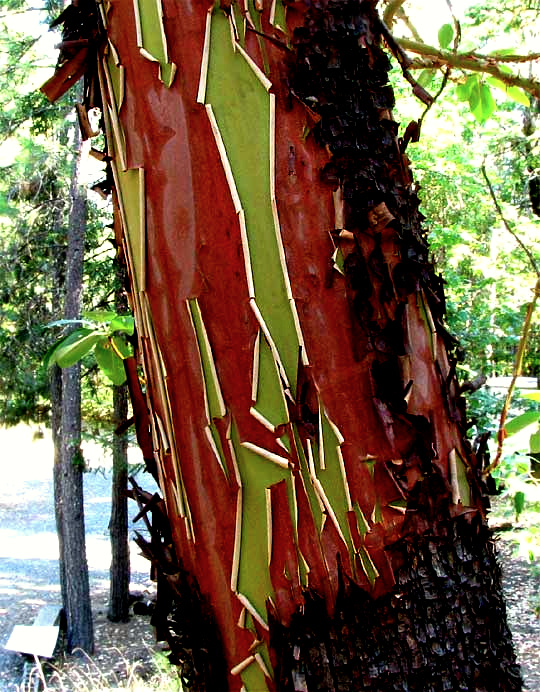
In the afternoon of the second day, we visited a fledgling ethnobotanical garden and did some key-based plant identification. Then we designed an interpretive sign for the plant we identified, listing two traditional native uses of the plant. Our plant was Arbutus menziesii, or Pacific Madrone, with its interesting red (chartreuse when young!) peeling bark and waxy evergreen leaves. It turns out that this plant was used by the Saanich people for making dye, as a remedy for colds and tuberculosis, and as a contraceptive. What a great service learning project this would be for kids! This project could easily highlight the vital role native plants play in the watershed ecosystem, the negative impact of introduced natives (the removal of which would be another great service leaning opportunity), the importance of our native plants to indigenous peoples, to animals, and to us today, and the design of interpretive signs for the garden that reflect their newfound knowledge and enhance the experience of future visitors.

The whole weekend was an amazing opportunity. I am so happy to have been involved. Even though I am not yet teaching, I now have a lot of things in my toolbox that I can draw on and utilize when I’m in the classroom. I think that programs like these are very important for our kids to realize that what we talk about in classrooms is stuff that directly relates to both them as individuals (we all need clean water, for example) and to the world around us. It also gives kids a way to learn experientially, which is such a powerful way to reinforce learning. It also can provide a way for them to help their communities simultaneously. The workshop even addressed ways to make these types of learning experiences a reality in today’s world of budget cuts and cancelled field trips. NOAA provides grants for your classroom! I’m thankful to whoever posted the information about this workshop to our cohort list, though I’ve forgotten who it was!

Wednesday, May 12, 2010

relevance

[T]he brain learns better when the heart (that is, our emotions) and our hands are actively engaged in the learning. - Diane Demee-Benoit

Ayers’ chapter in his book To Teach titled “Liberating the Curriculum,” addresses the very important issue of making education relevant, interesting, and challenging to our students. Ayers asks what’s most important to teach our students - “what knowledge and experiences are worthwhile” (Ayers, 2001, p. 88) - and I think that simply asking that question is a good first step toward realizing that education isn’t all about parceling out discrete units of trivial knowledge to our kids. This realization isn’t new, and clearly, there is no single “correct” answer to this question - it’s been pondered both before and since Dewey wrote his Pedagogic Creed. As quoted in my April 14th blog post, Dewey averred that “if we eliminate the social factor from the child we are left with only the abstraction” all the way back in 1897. He added that “school must represent life - life as real and vital to the child as that which he carries on in the home, in the neighborhood, or on the playground.” (1897) Ayers is not the first person to contemplate this question and posit possible solutions (and he won’t be the last).

Much of what Ayers wrote in this week’s chapter is also strikingly similar to another recent reading of mine, a chapter entitled “Pursuing Relevance” in Teaching as a Subversive Activity. Postman & Weingartner write of a hypothetical doctor who administers penicillin as a matter of course - whether needed or not - because he believes that its administration is inherently good. Some patients recover, some die. No discretion, no attention to symptoms or circumstance, is utilized when prescribing it. Such a position, Postman & Weingartner emphatically write, is not at all dissimilar to the approach often taken regarding education. When such a system is in place, one where dispensing knowledge for knowledge’s sake trumps all other factors and considerations, they bid us ask: “Where is the learner in all of this? Where is his world?” (Postman & Weingarten, 1969, p. 43)

So where are we left in pondering these questions? If we are in agreement with Dewey, Postman, and Ayers (as I am), then we can reasonably assume what education should not be. All three of these thinkers reach the same conclusion, that education shouldn’t be so abstracted as to lose all relevance to the children we’re teaching. Ayers describes a way of teaching that adapts and reacts to circumstances. He maintains that “youngsters need opportunities to choose, to name, and to pursue their own passions and projects.” (2001, p. 89) Making education relevant to their concerns helps forge a “living curriculum.” (Ayers, 2001, p. 89) Postman echoes Ayers. While education contemplates the reified “exotic interests” of those who decree the curriculum, Postman & Weingartner write back in 1969, “Native Americans are in open rebellion against their government [and] B-52s have dropped more bombs on Vietnam than were dropped on Germany in WWII.” (p. 57) Today, we could easily substitute the war in Iraq and the precarious global financial situation as “relevant” concerns ignored in favor of abstract curricula. Instead, however, many teachers still just dole out the penicillin.

The subject need be neither so large nor so weighty as the war in Iraq in order to be meaningful in our classrooms, either. The example given by Jane a couple of weeks ago in class of a classroom tackling a perceived intersection safety problem may be the biggest concern your classroom wants to deal with. In Jane’s example, the teacher responded to this (student driven) concern and adapted her curricula. The kids researched, proposed, and saw the implementation of a new intersection stoplight - and gained a wealth of integrated, interconnected, and relevant knowledge in the process. All of this - from questioning what knowledge is most valuable, to Dewey’s, Postman’s, and Ayers’ overlapping concerns, to Jane’s example of “real life” learning to gain integrated knowledge of the world - all of it brings to mind for me the concept of expeditionary learning.

My opening quote is from A Passion for Knowledge: An Introduction to Expeditionary Learning, written by Diane Demee-Benoit. I believe it captures the heart of expeditionary learning, which emphasizes both relevance and practical application. Expeditionary learning encourages students to probe a subject deeply and puts the focus on student investigations. For example, a first grade study of frogs approaches the subject from many disciplines, such as science, in exploring the life cycle of a frog, art, in creating artistic representations of frogs, and literature, in reading folklore about frogs. Demee-Benoit writes that she and her colleagues “saw that the kids who truly mastered a subject and developed a greater passion for learning were those who had the opportunity to learn with their mind, heart, and hands.” (2007)

A school close to where I live, Thornton Creek Elementary, uses the expeditionary learning model. I was fortunate to receive a tour of the school from a friend’s daughter who teaches there. This year, one of the 1st grade expeditions is the birds of Greenlake. They’ve been exploring the basic needs of all organisms and what a fair scientific test looks like. They’ve been looking at bird physiology. They’ve been looking at the variety of birds found at Greenlake: water, land, and dabblers. They’ve been learning scientific illustration and constructing their own field guides. The class, in short, is developing a deep knowledge of birds through hands -on, backyard experience. The knowledge they’re getting is both contextual and relevant. I, for one, find this to be a very interesting and effective way to address the questions raised by our reading. I only wish UWB was still placing student teachers there!

Ayers, W. (2001). To Teach: The Journey of a Teacher. New York. N.Y. & London: Teachers College Press.
Demee-Benoit, D. (June, 25th, 2007). A Passion for Knowledge: An Introduction to Expeditionary Learning. Edutopia. http://www.edutopia.org/introduction-expeditionary-learning.
Dewey, J. (1897 January). “My Pedagogic Creed.” School Journal vol. 54, 77-80
Postman, N. & C. Weingartner (1969). Teaching as a Subversive Activity. New York. N.Y.: Delacorte Press.

Wednesday, May 5, 2010

griot

Although we might agree that having a community is important, how do we know when we have one? - Mara Sapon-Shavin

This week’s readings by Mara Sapon-Shavin, Building a Safe Community for Learning, by Maxine Greene, Imagination, Community, and the School, and a reading for Jean Eisele’s class, Hello Grandfather: Lessons from Alaska, by Lisa Delpit, brought home for me both the importance and challenges of community building. One idea that resonates with me, which was articulated explicitly by Greene, is storytelling, and I was reminded of a talk I went to last year given by Jourdan I. Keith, founder of the Urban Wilderness Project. A large component of this project is the “Griot Works” - pronounced gree-oh - which cultivates storytellers. A Griot preserves community and culture through story, myth, and folklore. When I heard about this project, I thought it was a fabulous way to build community - and preserve the integrity of its component cultures. Everyone is welcome, children to adults, no matter your experience level or background. This project seems an ideal way to feel a deeper affinity for your own cultural background as well as providing an excellent way to experience the “other,” a concern of Delpit’s that I’ve given a lot of thought to. Building a strong storytelling tradition within a community could be a great way to “learn to see the other rather than merely look.” (Delpit, 1996, p. 91)

Another seductive quality of this project is that it promotes, in a sense, alternative “literacies.” A more comprehensive definition of “literacy” can be fostered when we incorporate traditional ways of sharing knowledge, like myth. As Delpit warns, “[w]e risk failure in our educational reforms by ignoring the significance of human connectedness in many communities of culture.” (1996, p. 95) Many of these cultures possess a strong oral tradition that uses folklore to stress this idea of connectedness. Using these stories to promulgate a deeper understanding of these connections is a good lesson for all of us. Similarly, Sapon-Shevin suggests a “diversity treasure hunt” (1995, p. 107) as a community building exercise. The end result of such an exercise would be a kind of story, too. Finding someone whose parents are from another country and exploring a tradition or custom that came from those parents writes a cultural story that can be shared with the community. I really liked that idea. Finding a way to integrate the Griot tradition in our classrooms would, in my opinion, help us learn about and from one another - and help to see each other more clearly. A strong sense of interconnectedness could develop - stories intersecting and complementing one another - and a healthy community of mutual respect can develop. Hearing and acknowledging each other’s stories is one way we can gauge the strength of our communities.

For Greene,“interconnectedness and communion” (1995, p. 33) characterize a strong democratic learning community. The arts, including storytelling, are an important component of this type of community. She writes that “teachers incapable of thinking imaginatively or of releasing students to encounter works of literature and other forms of art are probably also unable to communicate to the young what the use of imagination signifies.” (1995, p. 37) And it is imagination that “feeds one’s capacity to feel one’s way into another’s vantage point,” (Greene, 1995, p. 37) - or as Delpit says, the capacity to see the other.

What sounds like just a story can be a powerful element of Greene’s democratic community. The act of telling a story helps students find their voice. The story promotes an “emerging solidarity, a sharing of certain beliefs, and a dialogue about others.” (Greene, 1995, p. 39) It’s a way of talking about each other and to each other. Having open lines of communication is essential to a strong community, which must be able to both speak and listen. The story also wields enormous power to “break the hold of…constructed categories.” (Greene, 1995, p. 40) What we thought we knew about others and how we thought they fit into the world was, perhaps, merely a reflection of our own wishes and beliefs, not their reality. Stories can help us uncover the unknown truths about one another.

Delpit laments that when she went to Alaska she “was very much the ‘other’” with “no opportunity to see [herself] reflected in those around [her].” (1996, p. 104) The Griot tradition, I believe, can help answer that concern. Sapon-Shevin bids us ask whether our classroom practices will “bring students closer together…or push them further apart?” (1995, p. 112) Incorporating the Griot tradition, in offering a way to experience and empathize with the traditions and values of others, definitely encourages solidarity. Through stories, we “can keep seeking connection points among [our] personal histories.” (Greene, 1995, p. 42) Vitally, these stories and their resultant dialogue promote a respect for the diversity that makes up our communities, enabling us to evolve a relationship together that’s adaptable and open.

Delpit, L. (1996). 'Hello, Grandfather': Lessons from Alaska. In Other people's children: Cultural conflict in the classroom (pp. 91-104). New York, NY: The New Press.
Greene, M. (1995) Imagination, community, and the school. Releasing the imagination: Essays on education, the arts, and social change (pp 32-43). San Francisco: Jossey-Bass Publishers.
Sapon-Shevin, M. (1995). Building a safe community for learning. In W. Ayers (Ed.), To become a teacher: Making a difference in children's lives (pp. 99-112). New York: Teachers College Press.

Wednesday, April 28, 2010

difference

I no longer believe the old saying that you can learn something from anything. I now think, given the intense relationships and connections that exist everywhere, that you can learn anything from everything. (Ayers, 2001, p. 83)

The above quote in chapter 4 of To Teach, “Building Bridges,” struck a chord with me. Ayers goes on to say that the trick is to probe deeply and thoughtfully - that we as teachers “need to find ways to follow [knowledge] where it leads.” (2001, p. 83) While I hope to not romanticize or oversimplify Ayers’ words inappropriately, this concept really appeals to me, especially as it pertains to building bridges between cultural differences. Ayers once again provides us with appealing curricular possibilities. For instance, I see definite possibilities for a rite of passage exercise. I think a well-designed activity could be both an exploration of self and a centering influence in a time of flux for young adolescents.

That said, I must admit to a certain uneasiness as I read about Zayd’s own coming-of-age ceremony. It felt uncomfortable to me that he seemed to be co-opting another culture’s tradition and putting his own “spin” on it. I’ll admit that Zayd could well be Native American, his ethnicity is not mentioned in the chapter. When reading, however, my feeling was that he was not Native American. If by chance one of his classmates were, I wonder how Zayd’s activity would have been received. As a compliment? After all, Zayd found the Native American tradition inspiring enough to adapt to his own ceremony. As an insult? As an abuse of something sacred and personal? Would Zayd’s attempt be seen as akin to a white man in a headdress and makeup portraying a Native American on television? It reminds me of a story about the Dalai Lama, who was approached by a woman taken with Buddhist philosophy but who considered herself a Christian. When she asked him if she should convert, the Dalai Lama told her that she should simply be the best Christian she could.

The danger I’m seeing in the above example, I believe, is the seductiveness of the “other.” Our own heritage, traditions, and cultural artifacts may seem mundane and boring to us, but another’s heritage, traditions, and cultural artifacts may seem exotic and alluring. Many would willingly abandon their own cultural accoutrement for the tantalizingly new tradition. While doing so could perhaps be viewed as form of compliment to the tradition being adopted, there is also a very real risk of simply reducing the other tradition to a novelty. When the tradition becomes trivialized in this manner, it’s devalued, something to be tried on and discarded at will.

Ayers touches on these concerns when he talks about Christmas. In an effort to be inclusive, Ayers first incorporates Hanukkah in his classroom. Soon thereafter, Kwanzaa is “discovered.” Then the pagan rite of Winter Solstice celebration, followed by Three kings Day, then Epiphany. Pretty soon a smorgasbord of holidays is on the agenda, and “the treatment of culture as curiosity, a people’s story as a token gesture,” (Ayers, 2001, p. 79) becomes a real possibility that must be consciously avoided.

Along these same lines, I am also wary of cultural groups co-opting the hate language used against them. I didn’t always feel this way. At one time I was highly supportive efforts such as co-opting the word “queer” when referring to gays and lesbians. It made sense to me that taking the word away from the bigots who hurled it as epithet stripped it of its invective power and transformed it into an empowering rallying cry. While I still believe this to be true to some degree, I am not sure anymore whether this value is enough to overcome the inevitable confusion over its proper use. Can a heterosexual sympathizer use “queer” with confidence? The line of acceptability is very blurred. I believe the confusion is even more apparent with epithets co-opted by African Americans, such as the “n” word.

I could be totally off base with these thoughts, but I felt the need to articulate them. Perhaps I see pitfalls I’m particularly determined to try and avoid. However, this chapter din't just give me concerns. As I touched on at the beginning of tis post, it also gave me inspiration. While Zayd’s individual experience made me a little uneasy, the general idea of a coming-of-age project or something similar is very appealing to me. I was also very interested in Ayers' ideas about involving kids in a study of their own community. His idea of using “trips, interviews, mapping, comparing, following leads, [and] exploring the complexity of a community’s life” to study, appreciate, and bridge difference really attracts my attention.

Those kinds of “at hand” experiences - the ones that really provide meaning for students by asking questions about their own lives - can provide the needed context for kids to begin to appreciate one another for who each of them are. Like Ayers says, it provides a way for students to explore difference not merely as other cultures existing “out there,” but to see and cultural issues that exist “in here,” in one’s own classroom. Related to this were his ideas about studying cultural stereotypes. In particular, I really liked the idea of naming three groups one belongs to and exploring one negative attribute given to that group. While Ayers exercise was structured for college students, I believe it could be tweaked to work in a younger classroom. Again, Ayers has given us good food for thought. I hope I become the kind of teacher who builds bridges, probes deeply, and follows the knowledge of the world where it leads me.

Ayers, W. (2001). To Teach: The Journey of a Teacher. New York. N.Y. & London: Teachers College Press.

Wednesday, April 21, 2010

seeing students, classroom caring

When we teachers look out over classroom, what do we see? Half-civilized barbarians? Savages? A collection of deficits, or IQs, or averages? Do we see fellow creatures? (Ayers, 2001, p. 28)

Since I finished this week’s assigned reading - chapter 2 of William Ayer’s To Teach - a while ago, I sat down this morning to refresh myself on its content. As I did so, I was struck by the parallels between Ayers discussion of “Seeing the Student,” and this week’s readings for my Middle School Learners class, which centered on caring classrooms. One quote from these readings was “[E]ducation must focus on teaching all people how to live in an inclusive community where each person is treated with respect and dignity and enlisted to participate fully in the life of the community.” (Beck & Malley, 1998, p. 137) This and similar emphases ran throughout the readings. As Ayers discussed finding ways to engage students as whole persons, I recalled similar sentiments such as a particular passage which discussed how academic success is often difficult to achieve without ensuring students’ emotional and social well-being first.

To me, these kinds of thoughts dovetail nicely with Ayers assertion that we must strive to defeat the impulse toward deficit education - that “brainstorm[ing] a list of deficiencies” and then creating “a curriculum to correct these deficiencies” (2001, p. 29) is a destructive policy that strips individuals of their value. Focusing on correcting the deficits of our students grants educational strategies a distinct negative stance and says nothing about what students “know or care about,” or their “temperament or disposition of mind.” (Ayers, 2001, p, 30) Without knowledge of our students as whole persons, how can we incorporate a culture of caring in our classrooms? We run the risk of transforming students into checklists, marking success with an “X” in the box next to each insufficiency. As Ayers reminds - while not dismissing the real needs for students to learn certain skills - such a strategy only succeeds in making one feel rotten about one’s self.

In fact, in uncaring classrooms - such as might be created by transforming students into “to do” lists, - learning actually suffers. When students are seen as the sum of what they cannot do, when the fear is an inability to “measure up,” the result is too often exclusion from “participation in substantive academic interactions.” (Gay, 2000, p. 53) Ayers entreats us to construct an image, through careful attention and analysis, of our students as whole persons. He reminds us to base our observations “in many dimensions at once: intellectual, cultural, physical, spiritual, [and] emotional.” (Ayers, 2001, p. 33) When we have such a view of our students, learning both occurs more holistically, but also more deeply. When our students ‘ complex personal character - whether caring, patient, problem solving, or what have you - isn’t subsumed by his or her deficits, new approaches evolve, expectations are raised. As Gay writes, shifting focus toward caring supports strong academics: “[P]erformance expectations are complemented [by] uncompromising faith in…students and relentless efforts in helping them meet high academic demands.” (2000, p. 76)

One complaint I hear about this strategy of meticulous observation in order to “know the full measure of your students” (Ayers, 2001, p. 33) is that teachers simply don’t have enough time. In a classroom with 30 students and a packed curriculum, how do you manage to carefully observe each child’s individual interactions and document them carefully so you can compile a good composite later on? I’m not sure there’s an easy answer to that question, although Ayers suggestion to jot a short journal entry at the end of each day is probably one starting point I’ll attempt. I do believe that his strategy is an effective one and the effort, worthwhile. Without having been in a teacher’s shoes, however, it’s impossible to condemn an individual teacher’s conclusion that it can’t be done.

Classroom strategies suggested by Ayers really impressed me. Some of them may even suffice as a kind of response to objections based on time constraints. Some of his activities would be fine substitutes for a sociologically-styled pencil and notebook approach to observing students. For instance, one of the activities he suggests is teaching students how to interview one another, then giving them a microphone and a recorder and letting them have at it. All sorts of fascinating or even troubling insights could come from an exercise like this. You could learn that a student wants to be an astronaut or that one has an abusive home life. Both could frame your future interactions. Ayers is correct, in my opinion, when he concludes that “[w]hen teacher’s value their children’s opinions and experiences, children begin to think more openly, and we begin to see them differently.” (2001, p. 42)

Another great idea that I just loved was bringing in a “cultural artifact” from home. Selecting such an object would be a deeply personal choice for each student. As a result, knowledge of each individual student, of what’s important to him or her, and even of his unique culture, would all be divulged as the presentation of each object unfolded. This activity, in addition to being of enormous value to the teacher in gaining a sense of each of his pupils as persons, would also be of enormous value to the classroom as a whole. Activities like this help create a culture of caring in the classroom - they help students expand their worldviews to incorporate difference. Individuals also feel “validated…stronger, more able.” (Ayers, 2001, p, 42)

In all, I very much enjoyed Ayer’s chapter “Seeing the Student.” I believe he strongly advocated for and defended the notion of treating our students as the whole persons that they actually are, not just with weaknesses, but with unique strengths as well. I believe that by trying to incorporate some of the strategies outlined by Ayers in our classrooms, we can not only formulate a sense of who each of our students is a human being, but simultaneously foster a strong cooperative climate of caring in our classrooms. These dual strengths - creating positively attributed students who care about each other, will also help create a learning atmosphere capable of great academic achievements by its members. My hope is to become the kind of teacher who is able to see past the students’ deficits and deficiency- centered teaching and incorporate some these great ideas.

Ayers, W. (2001). To Teach: The Journey of a Teacher. New York. N.Y. & London: Teachers College Press.
Beck, M. and J. Malley (Fall 1998). “A Pedagogy of Belonging,” in Reclaiming Children and Youth, p. 133
Gay, G.(2000). Culturally Responsible teaching: Theory, Research, and Practice. New York: Teachers College Press.

Wednesday, April 14, 2010

ideas

All journeys have secret destinations of which the traveler is unaware. - Martin Buber

Last week, Jane asked me a couple very good questions about methods and quantifying knowledge. I’ve thought about it a bit, and have a few ideas. First I’d like to talk a little bit about “showing how narrow a range of learning is actually captured in tests.” I was fortunate to finally receive a book by Diane Ravitch last week, titled The Death and Life of the Great American School System. I’d been on the library’s waiting list quite a while for that one! I think that the exposure her book has gotten coupled with the fact that she’s a powerful figure in the world of education whose views about "accountability" have undergone a dramatic reversal will do wonders to shed light on the narrow range of learning captured in tests. The fact that her book seems to have wide appeal - I was three hundred and something on the library’s waiting list when I signed up - will help many outside of academia realize that we chose poorly when we decided to prescribe methods that focused narrowly on teaching to tests - and only to two tests, reading and mathematics - at the exclusion of everything else, and prescribed standardized testing as a measure of schools’ success or failure.

Treating education as if it were a business, placing undue emphasis on top-down management of schools, choice, and accountability, has not worked. In fact, in Texas, classroom methods devolved into a curricula that simply taught to the test, teaching skills such as strategies to use when answering multiple choice questions. This raised test scores, and Texas was seen as an impressive success of No Child Left Behind (NCLB). However, students trapped in this accountability-centered abyss, when given a text to review, were incapable of writing “a thoughtful response to a question that asked them to present evidence from what they read.” (Ravitch, D., 2010, p. 108) Drilling for and succeeding on the tests became the overriding educational goal of schools in Texas - and all over the United States similar patterns emerged. Students in an elementary school in Annapolis performed impressively on the state assessments - teachers assiduously practiced skills such as how to answer questions likely to appear on the state test. This achievement was at the expense of general knowledge, though, and students “lacked the vocabulary and general knowledge to succeed in high school.” (Ravitch, 2010, p. 109) As Ravitch describes them, they were trained, not educated. If public opinion hasn’t swayed against this undue emphasis on testing by 2014 - when 100% proficiency is mandated and we will definitely have not achieved 100% proficiency unless standards are lowered - at that time minds should certainly start changing, in my opinion.

If we hope to achieve success in turning American public education away from "assessment," we’ll have to have thought out and considered alternatives. The Buber quote I opened with is apropos of how I feel we should approach education. Knowledge is the disclosure of the previously undisclosed and we can't imagine all we might discover. I was asked in last week’s blog post, “[H]ow is it that teachers can articulate a richer understanding of what students like [Kelyn] *are* learning and why those things are important for the children and for the world that they'll eventually lead?" I think there are many different ways to quantify what our kids are learning (I’ll add that I think it’s unlikely that standardized tests are quantifying what kids are learning, even though that’s what they purport to do). Tests could be structured so that critical analysis of what one has learned is evaluated - short answer and essay tests immediately come to mind, but other “tests” come to mind, perhaps a multimedia presentation, or a skit, or even a model. Our recent readings in Jean Eisele’s class that talk about multi-ability classrooms suggest another possible alternative. Group learning could be structured around individual strengths, and assessments could be made based on kids’ ability to help their fellows grasp the concepts related to their “expertise.” Multicultural classrooms could have children teaching their peers about their cultural individuality, such as their cuisine or their traditions. As Oakes & Lipton point out, “complex, realistic, multidimensional assignments and projects” enable children to “discover and combine their particular strengths with areas where they are not strong or lack experience.” (2007, p. 173) At any rate, any and all methods of assessing knowledge should be particular to what’s being learned and as much as is practicable, to the individual learner. This could mean offering the learner the opportunity to demonstrate what he’s learned in the venue/medium he’s most confident in.

The second half of the above question - why is this knowledge important - is addressed, I believe, in last week’s Dewey reading for Jean Eisele’s class. Before I discuss that, however, I’d like to proclaim my belief that NCLB-style education hasn’t demonstrated to our kids why the knowledge we’re handing out is important. Our system of so-called accountability has stripped knowledge of its context and what we’re producing is adults who can’t relate what they’ve learned to real world situations. We’ve seen examples of this throughout our readings, such as in a story of graduates who cannot see the direct connection between a learned mathematical principle and its real world application. We’ve created a strong dichotomy between knowledge, which is treated as esoteric, and application, which is often seen as of secondary importance. This leads us back to Dewey’s premise - still valid after over 100 years - that we learn what we do. How do we make knowledge important to our kids? Contextualize it to their experience. As Dewey stated in My Pedagogic Creed: “If we eliminate the social factor from the child we are left with only the abstraction.” (1897) he further states that “school must represent life - life as real and vital to the child as that which he carries on in the home, in the neighborhood, or on the playground.” (1897)

If we give our kids an education grounded in their reality, we’ve taken the first big step in producing intelligent adults able to make real life connections and with the ability to make moral and ethical choices. Where does this ability come from? When we teach to our context, we are encouraging our kids to develop critical thinking skills as they apply their knowledge to and make informed judgments about our larger world. We’ve imbued education with relatability - which shows cause and effect, incorporates a diversity of experience, and illuminates connections between individual and knowledge.

Dewey, J. (1897 January). “My Pedagogic Creed.” School Journal vol. 54, 77-80
Oakes, J. and M. Lipton (2007). Teaching to Change the World. Boston: McGraw Hill.
Ravith, D. (2010). The Death and Life of the Great American School System: How Testing and Choice are Undermining Education. New York. N.Y.: Basic Books

Wednesday, April 7, 2010

the sun rises in the brazen sky to shine on mortal men

"I know that I celebrate a kind of teaching that is exceedingly rare. I know that becoming an oustanding teacher is an heroic quest: Like Odysseus one must navigate turbulent and troubled waters...on the way toward an uncertain reward." (Ayers, 2001, p. 10)

In the first chapter of To Teach, titled "Beginning, the Challenge of Teaching," William Ayers calls us to evaluate what a decision to teach really embodies. Ayers analyzes obstacles in both thought and practice, he dispels myths, and he articulates some characteristics of good teaching. He sets out in a manner that really appealed to me - giving examples that highlight the importance of finding something of value in students. I was so impressed to hear about the young student, Kelyn, who found in his "difference" a source of pride. However, nurturing whole students like Kelyn, possessing healthy self esteem, means that we can't construe teaching to be simply the act of disseminating prescribed knowledge through instruction. This fact is easily overlooked. In recent years, such great emphasis has been placed on the successful transfer of prescribed knowledge from the teacher's curriculum-focused lesson plan to the students' brains - and then quantifying that knowledge through standardized testing, that is hardly surprising that important roles of the teacher have been neglected. Additional roles are required to create whole learners - modeling, listening, and interacting, to name a few that Ayers highlights.

Shifting our focus from content to method adds more dimensions to teaching. While it creates new challenges for the teacher, it also grants additional, sometimes immeasurable, rewards. "Teaching is spectacularly unlimited," Ayers reminds us (2001, p. 5), and this reminds me of why I chose to pursue teaching. To paraphrase Ayers, I chose teaching because I love what happens to me when I'm with children in the classroom, because I love watching them open up and grow, because I want to be a part of shaping and touching the future. Understandably, I believe, I got a little depressed when I read what came next - all the reasons not to teach, all the unfavorable attitudes we'll face, all the real challenges placed on teachers. I'll confess to something. Twenty years ago I would have laughed at the notion of becoming a teacher. When someone said to me "Those who can, do, those who can't, teach," my reply was, "Hear, hear." How opinions change! Even so, I grew a bit downcast as I read through his list - teachers are seen as intellectually deficient, teachers are seriously undervalued by society, teachers are paid a pittance, and on and on. Yes, yes, I know. Let's get on to how we can effect change! I was glad when he finally got to the part about teaching still being a powerful calling.

In the section on myth-dispelling, Ayers thoughts really struck me, especially in a few specific sections. One instance is when he discusses "Myth 4: Good Teachers Always Know the Materials." (2001, p. 12) The statement that "[m]any fine teachers plunge into the unknown alongside their students," (Ayers, 2001, p. 13) couldn't be a clearer articulation of one of of the reasons I chose teaching. The excitement of sharing in discovery with my students is a particular thrill. There's an almost indescribable elation that comes from discovery - and there are always new things for everyone to learn. Another myth that really stood out is that quality teaching can be measured through testing. The primary reason this myth stood out is because it's commonly, and frequently, cited as truth. In fact, it scarcely seems possible that there could be more emphasis placed on testing than there is today. Ayers isn't the only author to try and dispel this myth. Others, including Berliner & Biddle in my "Context of Learning and Schooling" class reading this week, "The Manufactured Crisis," refute this - even Diane Ravitch, proud endorser of the "No Child Left Behind" act, seems to have changed her mind. Yet the myth persists. I find myself wondering, why? Just yesterday, a new coalition to promote teacher contract changes rooted in so-called teacher performance, was reported on by NPR. Have these folks - "Communities and Parents for Public Schools" - read the research, or, at the very least, talked to any teachers? The persistence of this myth confounds me.

Ayers gave me a lot of additonal things to think about in this chapter, but I'll wrap up here by talking about his "ethic of caring," since I think it's some of the most important advice to heed. For Ayers, everything about teaching seems to boil down to love for the student. If our first priority is the student, if our first commitment is to the students' well-being, then the kinds of learning and types of learning environments required to foster empowered learners like Kelyn will follow. As Ayers states, the teacher that chooses to embrace "the 'difficult matter of moral choice'," (2001, p. 21) chooses, "to do something that enables the choices of others, that supports the human impulse to grow." (2001, p. 22) Though this choice entails difficulty, and as hard as holding my "own experiences as tentative...and open to question," (Ayers, 2001,. 22) may be, this is the kind of teacher I'd like to be. I believe this approach to teaching is will reap the "deeper, more lasting, and less illusory" (Ayers, 2001, p. 24) rewards.

Ayers, W. (2001). To Teach: the journey of a teacher. New York. N.Y. & London: Teachers College Press.

Monday, April 5, 2010

thoughts on the lenses through which we view education

Whenever we choose to examine education - its purposes and intents, for example - we cannot discern anything uncolored by context. Our experiences and perspectives leave an indelible mark on our psyches; marks which influence our opinions and our priorities. For myself, on examining the list of perspectives from which we view education - “developmental, psychological, pedagogical, political, policy, historical, social, economic, cultural, and ethical” (Van Galen, n.d., p. 2) - I am immediately struck by how much these different approaches overlap one another. It may be impossible to get a clear view of what the political lens reveals without also considering the economic lens, for example. We must additionally acknowledge the biases our personal experiences have imprinted on us with regards to both politics and economics. From this starting point, while we can find common ground and begin to address some of our “big” questions about education, we must stand ready to revise our thinking and embrace change in the future. Values change, contexts change, new priorities are discovered. In this sense, our lenses reveal a kaleidoscopic range of perspectives and truths about education.

For me, our context does not merely color our opinions and attitudes with bias - though they challenge us to be mindful of other points of view, not all of our experience and opinions are negative. Our context is a valuable and important element that any workable solution should be grounded in. Dewey believed that “we learn what we do,” (Postman & Weingartner, 1969, p. 17) - a belief mirrored in McLuhan’s assertion that medium and message are one and the same. These thinkers instruct us to remember that the environment in which learning is conducted is at least as influential, at least as important as the content. As Postman and Weingartner remind: “[T]he critical content of any learning experience is the method or process through which the learning occurs.” (Postman & Weingartner, 1969, p. 19) In my opinion, realizing the enormous power that where we come from, who we are, and where we stand have on big overarching questions like “What knowledge is of most worth? Who decides?” (Van Galen, n.d., p. 3) is very important to keep in mind.

We cannot expect the answers to our questions about education to come to us as Platonic forms or Golden Rules that will magically transform education into an incorruptible ideal. Our answers will alternately be brilliant and bad - both messy and mutable. The questions will always be before us, with at least one question, courtesy of Jane Van Galen, that we should continually reflect on as educators: “Did I do the right thing?” (n.d., p. 5)


Postman, N. & C. Weingartner (1969). Teaching as a Subversive Activity. New York. N.Y.: Delacorte Press.
Van Galen, J. (n.d.). Lenses [PowerPoint slides]. Retrieved from http://www.bb.bothell.washington.edu/

Thursday, April 1, 2010

a poem to begin

[As once the winged energy of delight]

As once the winged energy of delight
carried you out over childhood's dark abysses,
now beyond your own life build the great
arch of unimagined bridges.

Wonders happen if we can succeed
in passing through the harshest danger;
but only in a bright and purely granted
achievement can we realize the wonder.

To work with Things in the indescribable
relationship is not too hard for us;
the pattern grows more intricate and subtle,
and being swept along is not enough.

Take your practiced powers and stretch them out
until they span the chasm between two
contradictions...for the god
wants to know himself in you.

- Rainier Maria Rilke