The raw space is a shell, determined, simply there. What happens next is active choice - life is breathed into these settings by people who have certain ideas in mind, specific beliefs to enclose. (Ayers, 2001, p. 49)
I believe that chapter three of William Ayers To Teach - “Creating an Environment for Learning” - is one of the most important chapters in the book. Creating an environment conducive to learning is a very important step that every teacher should give careful consideration to. The effects on one’s environment on the psyche are well documented, from the climate one lives in, to the neighborhood one lives in, to the color that the bedroom walls are painted. I remember reading a study long ago that Father Baker pink was the most soothing color in the spectrum and had a dramatic effect on people psychologically - it's clear that our surroundings influence us.
There are many important points in Ayer’s chapter that I’d like to discuss, but first I’d like to mention that it’s not just the individual classroom’s environment, or even the atmosphere of the school building as a whole, that’s singularly critical - I believe that the total environment of the school has a dramatic impact on learning. Too many children must walk to school in neighborhoods that are decrepit and crime-ridden and attend schools that are forced to use video cameras and metal detectors because the threat of violence is so great. These factors influence ability to learn. Maslow’s hierarchy of human needs is clear that safety needs to be addressed before intellectual pursuits can be successfully engaged in. Improving the total environment of schools should be a high priority for us. Ayers’ words, while not referring specifically to violence in schools, are still apropos: “Questioning everything in the environment…is an important task for teachers. We cannot necessarily change it all, but we can certainly become aware of the messages.” (2001, p. 51)
That said, in schools like these, the individual classroom environment takes on additional importance for kids, because the classroom can provide a nook of safety. Should I find myself teaching in a school with less than ideal conditions for learning, my first hope would be to create a classroom where kids feel safe. Elements of the physical space can do this - I picture warm textiles and comfy, cozy, reading areas - but the biggest step will be to engage in classroom community building. Perhaps the children themselves will have ideas for creating a physical environment that will help them feel more at ease.
Once I’ve tried to create a safe space, I’d like to try and create a space that also encourages active learning. Like Ayers, “I want to build spaces that are laboratories for discovery and surprise.” This early in my quest to become a teacher, I have no real idea what I’ll do with the physical space of my classroom. I do know it will strongly incorporate a sense of wonder (something I’ve never lost), a love of reading, history, and science, and space for hands-on learning. My passion for experiential learning must also be incorporated somehow in the scheme of things. Again like Ayers, I’d like to show my kids that “knowledge [is] available to them and [is] not some fixed entity locked up in textbooks, and that learning can be exciting, potentially awesome, and deeply satisfying.” (Ayers, 2001, p. 57) As much as I’d like my classroom to be an inspiring place for all kinds of learning to occur, I’d also like to get out of the classroom too, even if only figuratively. I’d like my classroom to be a place where imagination can soar.
part II: more on assessment
First of all, on the topic of assessment, I wanted to note a realization that came to me this past week. In one of my classes, we just turned in the single assessed document required for the entire term. I felt a little uneasy about this important writing assignment as I was wrote without a sense of what the instructor’s writing expectations were. In the class I am writing this blog for, of course, we aren’t even being assessed in the traditional sense. That got me thinking about my own attitudes toward assessment. While I ambivalent about standardized assessment, I am, personally, also an assessment junkie. This makes me a walking contradiction, but I do have to admit that I very much missed being assessed this term. This realization is important, because a mini straw poll I conducted in class uncovered a few more people who felt the same way. When I’m trying to create some kind of authentic assessment for my kids, I think I’ll need to remain aware of or uncover just how important a concrete “rating” of their work is to some of them.
I’ve already spoken about some ideas for authentic, alternative assessment in a few of my previous blog posts, but there were a few things in Ayers’ chapter “Keeping Track,” that resounded with me. First, echoing my thoughts above, was his discussion of how seductive standardized assessments are in terms of making us feel good about our kids (or ourselves when we take the West-Es) when they perform well, even as we realize that the standardized assessment was inherently flawed and unfair. I also liked Ayers’ description of the “3ps” of alternative assessment: “projects, portfolios, and performance.” (Ayers, 2001, p. 116) His description of how understanding what we value is the first step in authentic assessment was spot on for me, too. We have to be able to articulate the goals before we can successfully assess what’s been learned. I hope to successfully bear out Ayers' ideas when I'm teaching.
Ayers, W. (2001). To Teach: The Journey of a Teacher. New York. N.Y. & London: Teachers College Press.
Wednesday, May 26, 2010

Wednesday, May 19, 2010
integrated learning, service education: a weekend experience
This past weekend I had the fantastic opportunity to participate in a two day watershed education workshop sponsored by Service Education Adventure (SEA), Learn and Serve Environmental Anthropology Field (LEAF), and the National Oceanic and Atmospheric Administration (NOAA). Funded by grants provided through NOAA’s Bay-Watershed Education and Training (B-WET), this and similar workshops aim to give teachers the knowledge and resources necessary to get classrooms involved in watershed issues, to see the web of real-world connections that watershed issues embody, and to get kids and classrooms out in the field.
The first day we went out on a part-time research vessel, the Indigo. The day was spent in rotations: one discussing resources and curricula, another learning about the marine environment - which included trawling for plankton and observing it under a microscope, a third learning how to track animals that make their home in watershed basins, and the last learning marine navigation skills (yes, we all got to "drive" the boat!). We also spent a good portion of the afternoon on a beautiful beach at low tide making field observations. This was the first time I ever held an enormous moon snail in the palm of my hand!
The rotations, I felt, did a very good job of highlighting just how interconnected even seemingly disparate areas are. Who would have immediately connected tracking bears with watershed issues? Yet the bear requires a healthy watershed to survive. Who would’ve recognized that the health of the plankton we observed on the boat directly related to the health of all the marine creatures we observed on the beach? Our jam-packed, eye-opening, and educative first day was a strong reaffirmation of my feelings about interdisciplinary teaching and learning. It reinforced my opinion that we can’t hope give our students holistic knowledge about the world and how it works when we chop knowledge up into discrete little cubes and then serve it to our students with a complete lack of context.
Day two was also great, even though we weren’t out on a boat. The day’s classroom instruction was a chance to get some hands-on knowledge about a couple of service learning projects that we could do with our kids. As is probably clear by now, integrated/interdisciplinary learning is one of my great interests, and, to me, adding a service component makes it just that much more attractive. First on the workshop agenda was a presentation by a Stilly-Snohomish Fisheries Enhancement Task Force researcher, who talked with us about both watershed education in general and about water testing.
From her we received a very good overview of how to engage our students in understanding both what a watershed is and about watershed issues - and then we got to learn how to do water tests! Water testing kits are free from Sound Citizen, an organization which is a great starting point for building an experiential or service oriented watershed curriculum. One’s classroom can test anything from a major river’s water, to the water in a ditch by the school, even the school’s own grey water. While simple tests can be done in the classroom, such as turbidity and dissolved oxygen, the Sound Citizen kits are submitted with collection data -such as longitude and latitude of test site, whether salt, stream, lake water, etc. - and analyzed. Soon, your results will be graphed alongside other results on their website so comparisons can be made. This is a great way for kids to understand what “healthy” water looks like and why it’s important for all us and the ecosystem to have healthy water, while simultaneously assisting watershed research.
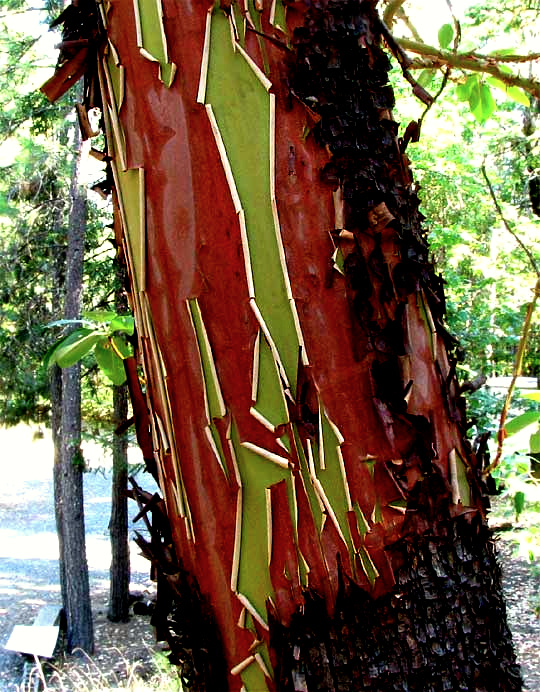
In the afternoon of the second day, we visited a fledgling ethnobotanical garden and did some key-based plant identification. Then we designed an interpretive sign for the plant we identified, listing two traditional native uses of the plant. Our plant was Arbutus menziesii, or Pacific Madrone, with its interesting red (chartreuse when young!) peeling bark and waxy evergreen leaves. It turns out that this plant was used by the Saanich people for making dye, as a remedy for colds and tuberculosis, and as a contraceptive. What a great service learning project this would be for kids! This project could easily highlight the vital role native plants play in the watershed ecosystem, the negative impact of introduced natives (the removal of which would be another great service leaning opportunity), the importance of our native plants to indigenous peoples, to animals, and to us today, and the design of interpretive signs for the garden that reflect their newfound knowledge and enhance the experience of future visitors.
The whole weekend was an amazing opportunity. I am so happy to have been involved. Even though I am not yet teaching, I now have a lot of things in my toolbox that I can draw on and utilize when I’m in the classroom. I think that programs like these are very important for our kids to realize that what we talk about in classrooms is stuff that directly relates to both them as individuals (we all need clean water, for example) and to the world around us. It also gives kids a way to learn experientially, which is such a powerful way to reinforce learning. It also can provide a way for them to help their communities simultaneously. The workshop even addressed ways to make these types of learning experiences a reality in today’s world of budget cuts and cancelled field trips. NOAA provides grants for your classroom! I’m thankful to whoever posted the information about this workshop to our cohort list, though I’ve forgotten who it was!
The first day we went out on a part-time research vessel, the Indigo. The day was spent in rotations: one discussing resources and curricula, another learning about the marine environment - which included trawling for plankton and observing it under a microscope, a third learning how to track animals that make their home in watershed basins, and the last learning marine navigation skills (yes, we all got to "drive" the boat!). We also spent a good portion of the afternoon on a beautiful beach at low tide making field observations. This was the first time I ever held an enormous moon snail in the palm of my hand!

The rotations, I felt, did a very good job of highlighting just how interconnected even seemingly disparate areas are. Who would have immediately connected tracking bears with watershed issues? Yet the bear requires a healthy watershed to survive. Who would’ve recognized that the health of the plankton we observed on the boat directly related to the health of all the marine creatures we observed on the beach? Our jam-packed, eye-opening, and educative first day was a strong reaffirmation of my feelings about interdisciplinary teaching and learning. It reinforced my opinion that we can’t hope give our students holistic knowledge about the world and how it works when we chop knowledge up into discrete little cubes and then serve it to our students with a complete lack of context.
Day two was also great, even though we weren’t out on a boat. The day’s classroom instruction was a chance to get some hands-on knowledge about a couple of service learning projects that we could do with our kids. As is probably clear by now, integrated/interdisciplinary learning is one of my great interests, and, to me, adding a service component makes it just that much more attractive. First on the workshop agenda was a presentation by a Stilly-Snohomish Fisheries Enhancement Task Force researcher, who talked with us about both watershed education in general and about water testing.
From her we received a very good overview of how to engage our students in understanding both what a watershed is and about watershed issues - and then we got to learn how to do water tests! Water testing kits are free from Sound Citizen, an organization which is a great starting point for building an experiential or service oriented watershed curriculum. One’s classroom can test anything from a major river’s water, to the water in a ditch by the school, even the school’s own grey water. While simple tests can be done in the classroom, such as turbidity and dissolved oxygen, the Sound Citizen kits are submitted with collection data -such as longitude and latitude of test site, whether salt, stream, lake water, etc. - and analyzed. Soon, your results will be graphed alongside other results on their website so comparisons can be made. This is a great way for kids to understand what “healthy” water looks like and why it’s important for all us and the ecosystem to have healthy water, while simultaneously assisting watershed research.
In the afternoon of the second day, we visited a fledgling ethnobotanical garden and did some key-based plant identification. Then we designed an interpretive sign for the plant we identified, listing two traditional native uses of the plant. Our plant was Arbutus menziesii, or Pacific Madrone, with its interesting red (chartreuse when young!) peeling bark and waxy evergreen leaves. It turns out that this plant was used by the Saanich people for making dye, as a remedy for colds and tuberculosis, and as a contraceptive. What a great service learning project this would be for kids! This project could easily highlight the vital role native plants play in the watershed ecosystem, the negative impact of introduced natives (the removal of which would be another great service leaning opportunity), the importance of our native plants to indigenous peoples, to animals, and to us today, and the design of interpretive signs for the garden that reflect their newfound knowledge and enhance the experience of future visitors.
The whole weekend was an amazing opportunity. I am so happy to have been involved. Even though I am not yet teaching, I now have a lot of things in my toolbox that I can draw on and utilize when I’m in the classroom. I think that programs like these are very important for our kids to realize that what we talk about in classrooms is stuff that directly relates to both them as individuals (we all need clean water, for example) and to the world around us. It also gives kids a way to learn experientially, which is such a powerful way to reinforce learning. It also can provide a way for them to help their communities simultaneously. The workshop even addressed ways to make these types of learning experiences a reality in today’s world of budget cuts and cancelled field trips. NOAA provides grants for your classroom! I’m thankful to whoever posted the information about this workshop to our cohort list, though I’ve forgotten who it was!
Wednesday, May 12, 2010
relevance
[T]he brain learns better when the heart (that is, our emotions) and our hands are actively engaged in the learning. - Diane Demee-Benoit
Ayers’ chapter in his book To Teach titled “Liberating the Curriculum,” addresses the very important issue of making education relevant, interesting, and challenging to our students. Ayers asks what’s most important to teach our students - “what knowledge and experiences are worthwhile” (Ayers, 2001, p. 88) - and I think that simply asking that question is a good first step toward realizing that education isn’t all about parceling out discrete units of trivial knowledge to our kids. This realization isn’t new, and clearly, there is no single “correct” answer to this question - it’s been pondered both before and since Dewey wrote his Pedagogic Creed. As quoted in my April 14th blog post, Dewey averred that “if we eliminate the social factor from the child we are left with only the abstraction” all the way back in 1897. He added that “school must represent life - life as real and vital to the child as that which he carries on in the home, in the neighborhood, or on the playground.” (1897) Ayers is not the first person to contemplate this question and posit possible solutions (and he won’t be the last).
Much of what Ayers wrote in this week’s chapter is also strikingly similar to another recent reading of mine, a chapter entitled “Pursuing Relevance” in Teaching as a Subversive Activity. Postman & Weingartner write of a hypothetical doctor who administers penicillin as a matter of course - whether needed or not - because he believes that its administration is inherently good. Some patients recover, some die. No discretion, no attention to symptoms or circumstance, is utilized when prescribing it. Such a position, Postman & Weingartner emphatically write, is not at all dissimilar to the approach often taken regarding education. When such a system is in place, one where dispensing knowledge for knowledge’s sake trumps all other factors and considerations, they bid us ask: “Where is the learner in all of this? Where is his world?” (Postman & Weingarten, 1969, p. 43)
So where are we left in pondering these questions? If we are in agreement with Dewey, Postman, and Ayers (as I am), then we can reasonably assume what education should not be. All three of these thinkers reach the same conclusion, that education shouldn’t be so abstracted as to lose all relevance to the children we’re teaching. Ayers describes a way of teaching that adapts and reacts to circumstances. He maintains that “youngsters need opportunities to choose, to name, and to pursue their own passions and projects.” (2001, p. 89) Making education relevant to their concerns helps forge a “living curriculum.” (Ayers, 2001, p. 89) Postman echoes Ayers. While education contemplates the reified “exotic interests” of those who decree the curriculum, Postman & Weingartner write back in 1969, “Native Americans are in open rebellion against their government [and] B-52s have dropped more bombs on Vietnam than were dropped on Germany in WWII.” (p. 57) Today, we could easily substitute the war in Iraq and the precarious global financial situation as “relevant” concerns ignored in favor of abstract curricula. Instead, however, many teachers still just dole out the penicillin.
The subject need be neither so large nor so weighty as the war in Iraq in order to be meaningful in our classrooms, either. The example given by Jane a couple of weeks ago in class of a classroom tackling a perceived intersection safety problem may be the biggest concern your classroom wants to deal with. In Jane’s example, the teacher responded to this (student driven) concern and adapted her curricula. The kids researched, proposed, and saw the implementation of a new intersection stoplight - and gained a wealth of integrated, interconnected, and relevant knowledge in the process. All of this - from questioning what knowledge is most valuable, to Dewey’s, Postman’s, and Ayers’ overlapping concerns, to Jane’s example of “real life” learning to gain integrated knowledge of the world - all of it brings to mind for me the concept of expeditionary learning.
My opening quote is from A Passion for Knowledge: An Introduction to Expeditionary Learning, written by Diane Demee-Benoit. I believe it captures the heart of expeditionary learning, which emphasizes both relevance and practical application. Expeditionary learning encourages students to probe a subject deeply and puts the focus on student investigations. For example, a first grade study of frogs approaches the subject from many disciplines, such as science, in exploring the life cycle of a frog, art, in creating artistic representations of frogs, and literature, in reading folklore about frogs. Demee-Benoit writes that she and her colleagues “saw that the kids who truly mastered a subject and developed a greater passion for learning were those who had the opportunity to learn with their mind, heart, and hands.” (2007)
A school close to where I live, Thornton Creek Elementary, uses the expeditionary learning model. I was fortunate to receive a tour of the school from a friend’s daughter who teaches there. This year, one of the 1st grade expeditions is the birds of Greenlake. They’ve been exploring the basic needs of all organisms and what a fair scientific test looks like. They’ve been looking at bird physiology. They’ve been looking at the variety of birds found at Greenlake: water, land, and dabblers. They’ve been learning scientific illustration and constructing their own field guides. The class, in short, is developing a deep knowledge of birds through hands -on, backyard experience. The knowledge they’re getting is both contextual and relevant. I, for one, find this to be a very interesting and effective way to address the questions raised by our reading. I only wish UWB was still placing student teachers there!
Ayers, W. (2001). To Teach: The Journey of a Teacher. New York. N.Y. & London: Teachers College Press.
Demee-Benoit, D. (June, 25th, 2007). A Passion for Knowledge: An Introduction to Expeditionary Learning. Edutopia. http://www.edutopia.org/introduction-expeditionary-learning.
Dewey, J. (1897 January). “My Pedagogic Creed.” School Journal vol. 54, 77-80
Postman, N. & C. Weingartner (1969). Teaching as a Subversive Activity. New York. N.Y.: Delacorte Press.
Ayers’ chapter in his book To Teach titled “Liberating the Curriculum,” addresses the very important issue of making education relevant, interesting, and challenging to our students. Ayers asks what’s most important to teach our students - “what knowledge and experiences are worthwhile” (Ayers, 2001, p. 88) - and I think that simply asking that question is a good first step toward realizing that education isn’t all about parceling out discrete units of trivial knowledge to our kids. This realization isn’t new, and clearly, there is no single “correct” answer to this question - it’s been pondered both before and since Dewey wrote his Pedagogic Creed. As quoted in my April 14th blog post, Dewey averred that “if we eliminate the social factor from the child we are left with only the abstraction” all the way back in 1897. He added that “school must represent life - life as real and vital to the child as that which he carries on in the home, in the neighborhood, or on the playground.” (1897) Ayers is not the first person to contemplate this question and posit possible solutions (and he won’t be the last).
Much of what Ayers wrote in this week’s chapter is also strikingly similar to another recent reading of mine, a chapter entitled “Pursuing Relevance” in Teaching as a Subversive Activity. Postman & Weingartner write of a hypothetical doctor who administers penicillin as a matter of course - whether needed or not - because he believes that its administration is inherently good. Some patients recover, some die. No discretion, no attention to symptoms or circumstance, is utilized when prescribing it. Such a position, Postman & Weingartner emphatically write, is not at all dissimilar to the approach often taken regarding education. When such a system is in place, one where dispensing knowledge for knowledge’s sake trumps all other factors and considerations, they bid us ask: “Where is the learner in all of this? Where is his world?” (Postman & Weingarten, 1969, p. 43)
So where are we left in pondering these questions? If we are in agreement with Dewey, Postman, and Ayers (as I am), then we can reasonably assume what education should not be. All three of these thinkers reach the same conclusion, that education shouldn’t be so abstracted as to lose all relevance to the children we’re teaching. Ayers describes a way of teaching that adapts and reacts to circumstances. He maintains that “youngsters need opportunities to choose, to name, and to pursue their own passions and projects.” (2001, p. 89) Making education relevant to their concerns helps forge a “living curriculum.” (Ayers, 2001, p. 89) Postman echoes Ayers. While education contemplates the reified “exotic interests” of those who decree the curriculum, Postman & Weingartner write back in 1969, “Native Americans are in open rebellion against their government [and] B-52s have dropped more bombs on Vietnam than were dropped on Germany in WWII.” (p. 57) Today, we could easily substitute the war in Iraq and the precarious global financial situation as “relevant” concerns ignored in favor of abstract curricula. Instead, however, many teachers still just dole out the penicillin.
The subject need be neither so large nor so weighty as the war in Iraq in order to be meaningful in our classrooms, either. The example given by Jane a couple of weeks ago in class of a classroom tackling a perceived intersection safety problem may be the biggest concern your classroom wants to deal with. In Jane’s example, the teacher responded to this (student driven) concern and adapted her curricula. The kids researched, proposed, and saw the implementation of a new intersection stoplight - and gained a wealth of integrated, interconnected, and relevant knowledge in the process. All of this - from questioning what knowledge is most valuable, to Dewey’s, Postman’s, and Ayers’ overlapping concerns, to Jane’s example of “real life” learning to gain integrated knowledge of the world - all of it brings to mind for me the concept of expeditionary learning.
My opening quote is from A Passion for Knowledge: An Introduction to Expeditionary Learning, written by Diane Demee-Benoit. I believe it captures the heart of expeditionary learning, which emphasizes both relevance and practical application. Expeditionary learning encourages students to probe a subject deeply and puts the focus on student investigations. For example, a first grade study of frogs approaches the subject from many disciplines, such as science, in exploring the life cycle of a frog, art, in creating artistic representations of frogs, and literature, in reading folklore about frogs. Demee-Benoit writes that she and her colleagues “saw that the kids who truly mastered a subject and developed a greater passion for learning were those who had the opportunity to learn with their mind, heart, and hands.” (2007)
A school close to where I live, Thornton Creek Elementary, uses the expeditionary learning model. I was fortunate to receive a tour of the school from a friend’s daughter who teaches there. This year, one of the 1st grade expeditions is the birds of Greenlake. They’ve been exploring the basic needs of all organisms and what a fair scientific test looks like. They’ve been looking at bird physiology. They’ve been looking at the variety of birds found at Greenlake: water, land, and dabblers. They’ve been learning scientific illustration and constructing their own field guides. The class, in short, is developing a deep knowledge of birds through hands -on, backyard experience. The knowledge they’re getting is both contextual and relevant. I, for one, find this to be a very interesting and effective way to address the questions raised by our reading. I only wish UWB was still placing student teachers there!
Ayers, W. (2001). To Teach: The Journey of a Teacher. New York. N.Y. & London: Teachers College Press.
Demee-Benoit, D. (June, 25th, 2007). A Passion for Knowledge: An Introduction to Expeditionary Learning. Edutopia. http://www.edutopia.org/introduction-expeditionary-learning.
Dewey, J. (1897 January). “My Pedagogic Creed.” School Journal vol. 54, 77-80
Postman, N. & C. Weingartner (1969). Teaching as a Subversive Activity. New York. N.Y.: Delacorte Press.
Wednesday, May 5, 2010
griot
Although we might agree that having a community is important, how do we know when we have one? - Mara Sapon-Shavin
This week’s readings by Mara Sapon-Shavin, Building a Safe Community for Learning, by Maxine Greene, Imagination, Community, and the School, and a reading for Jean Eisele’s class, Hello Grandfather: Lessons from Alaska, by Lisa Delpit, brought home for me both the importance and challenges of community building. One idea that resonates with me, which was articulated explicitly by Greene, is storytelling, and I was reminded of a talk I went to last year given by Jourdan I. Keith, founder of the Urban Wilderness Project. A large component of this project is the “Griot Works” - pronounced gree-oh - which cultivates storytellers. A Griot preserves community and culture through story, myth, and folklore. When I heard about this project, I thought it was a fabulous way to build community - and preserve the integrity of its component cultures. Everyone is welcome, children to adults, no matter your experience level or background. This project seems an ideal way to feel a deeper affinity for your own cultural background as well as providing an excellent way to experience the “other,” a concern of Delpit’s that I’ve given a lot of thought to. Building a strong storytelling tradition within a community could be a great way to “learn to see the other rather than merely look.” (Delpit, 1996, p. 91)
Another seductive quality of this project is that it promotes, in a sense, alternative “literacies.” A more comprehensive definition of “literacy” can be fostered when we incorporate traditional ways of sharing knowledge, like myth. As Delpit warns, “[w]e risk failure in our educational reforms by ignoring the significance of human connectedness in many communities of culture.” (1996, p. 95) Many of these cultures possess a strong oral tradition that uses folklore to stress this idea of connectedness. Using these stories to promulgate a deeper understanding of these connections is a good lesson for all of us. Similarly, Sapon-Shevin suggests a “diversity treasure hunt” (1995, p. 107) as a community building exercise. The end result of such an exercise would be a kind of story, too. Finding someone whose parents are from another country and exploring a tradition or custom that came from those parents writes a cultural story that can be shared with the community. I really liked that idea. Finding a way to integrate the Griot tradition in our classrooms would, in my opinion, help us learn about and from one another - and help to see each other more clearly. A strong sense of interconnectedness could develop - stories intersecting and complementing one another - and a healthy community of mutual respect can develop. Hearing and acknowledging each other’s stories is one way we can gauge the strength of our communities.
For Greene,“interconnectedness and communion” (1995, p. 33) characterize a strong democratic learning community. The arts, including storytelling, are an important component of this type of community. She writes that “teachers incapable of thinking imaginatively or of releasing students to encounter works of literature and other forms of art are probably also unable to communicate to the young what the use of imagination signifies.” (1995, p. 37) And it is imagination that “feeds one’s capacity to feel one’s way into another’s vantage point,” (Greene, 1995, p. 37) - or as Delpit says, the capacity to see the other.
What sounds like just a story can be a powerful element of Greene’s democratic community. The act of telling a story helps students find their voice. The story promotes an “emerging solidarity, a sharing of certain beliefs, and a dialogue about others.” (Greene, 1995, p. 39) It’s a way of talking about each other and to each other. Having open lines of communication is essential to a strong community, which must be able to both speak and listen. The story also wields enormous power to “break the hold of…constructed categories.” (Greene, 1995, p. 40) What we thought we knew about others and how we thought they fit into the world was, perhaps, merely a reflection of our own wishes and beliefs, not their reality. Stories can help us uncover the unknown truths about one another.
Delpit laments that when she went to Alaska she “was very much the ‘other’” with “no opportunity to see [herself] reflected in those around [her].” (1996, p. 104) The Griot tradition, I believe, can help answer that concern. Sapon-Shevin bids us ask whether our classroom practices will “bring students closer together…or push them further apart?” (1995, p. 112) Incorporating the Griot tradition, in offering a way to experience and empathize with the traditions and values of others, definitely encourages solidarity. Through stories, we “can keep seeking connection points among [our] personal histories.” (Greene, 1995, p. 42) Vitally, these stories and their resultant dialogue promote a respect for the diversity that makes up our communities, enabling us to evolve a relationship together that’s adaptable and open.
Delpit, L. (1996). 'Hello, Grandfather': Lessons from Alaska. In Other people's children: Cultural conflict in the classroom (pp. 91-104). New York, NY: The New Press.
Greene, M. (1995) Imagination, community, and the school. Releasing the imagination: Essays on education, the arts, and social change (pp 32-43). San Francisco: Jossey-Bass Publishers.
Sapon-Shevin, M. (1995). Building a safe community for learning. In W. Ayers (Ed.), To become a teacher: Making a difference in children's lives (pp. 99-112). New York: Teachers College Press.
This week’s readings by Mara Sapon-Shavin, Building a Safe Community for Learning, by Maxine Greene, Imagination, Community, and the School, and a reading for Jean Eisele’s class, Hello Grandfather: Lessons from Alaska, by Lisa Delpit, brought home for me both the importance and challenges of community building. One idea that resonates with me, which was articulated explicitly by Greene, is storytelling, and I was reminded of a talk I went to last year given by Jourdan I. Keith, founder of the Urban Wilderness Project. A large component of this project is the “Griot Works” - pronounced gree-oh - which cultivates storytellers. A Griot preserves community and culture through story, myth, and folklore. When I heard about this project, I thought it was a fabulous way to build community - and preserve the integrity of its component cultures. Everyone is welcome, children to adults, no matter your experience level or background. This project seems an ideal way to feel a deeper affinity for your own cultural background as well as providing an excellent way to experience the “other,” a concern of Delpit’s that I’ve given a lot of thought to. Building a strong storytelling tradition within a community could be a great way to “learn to see the other rather than merely look.” (Delpit, 1996, p. 91)
Another seductive quality of this project is that it promotes, in a sense, alternative “literacies.” A more comprehensive definition of “literacy” can be fostered when we incorporate traditional ways of sharing knowledge, like myth. As Delpit warns, “[w]e risk failure in our educational reforms by ignoring the significance of human connectedness in many communities of culture.” (1996, p. 95) Many of these cultures possess a strong oral tradition that uses folklore to stress this idea of connectedness. Using these stories to promulgate a deeper understanding of these connections is a good lesson for all of us. Similarly, Sapon-Shevin suggests a “diversity treasure hunt” (1995, p. 107) as a community building exercise. The end result of such an exercise would be a kind of story, too. Finding someone whose parents are from another country and exploring a tradition or custom that came from those parents writes a cultural story that can be shared with the community. I really liked that idea. Finding a way to integrate the Griot tradition in our classrooms would, in my opinion, help us learn about and from one another - and help to see each other more clearly. A strong sense of interconnectedness could develop - stories intersecting and complementing one another - and a healthy community of mutual respect can develop. Hearing and acknowledging each other’s stories is one way we can gauge the strength of our communities.
For Greene,“interconnectedness and communion” (1995, p. 33) characterize a strong democratic learning community. The arts, including storytelling, are an important component of this type of community. She writes that “teachers incapable of thinking imaginatively or of releasing students to encounter works of literature and other forms of art are probably also unable to communicate to the young what the use of imagination signifies.” (1995, p. 37) And it is imagination that “feeds one’s capacity to feel one’s way into another’s vantage point,” (Greene, 1995, p. 37) - or as Delpit says, the capacity to see the other.
What sounds like just a story can be a powerful element of Greene’s democratic community. The act of telling a story helps students find their voice. The story promotes an “emerging solidarity, a sharing of certain beliefs, and a dialogue about others.” (Greene, 1995, p. 39) It’s a way of talking about each other and to each other. Having open lines of communication is essential to a strong community, which must be able to both speak and listen. The story also wields enormous power to “break the hold of…constructed categories.” (Greene, 1995, p. 40) What we thought we knew about others and how we thought they fit into the world was, perhaps, merely a reflection of our own wishes and beliefs, not their reality. Stories can help us uncover the unknown truths about one another.
Delpit laments that when she went to Alaska she “was very much the ‘other’” with “no opportunity to see [herself] reflected in those around [her].” (1996, p. 104) The Griot tradition, I believe, can help answer that concern. Sapon-Shevin bids us ask whether our classroom practices will “bring students closer together…or push them further apart?” (1995, p. 112) Incorporating the Griot tradition, in offering a way to experience and empathize with the traditions and values of others, definitely encourages solidarity. Through stories, we “can keep seeking connection points among [our] personal histories.” (Greene, 1995, p. 42) Vitally, these stories and their resultant dialogue promote a respect for the diversity that makes up our communities, enabling us to evolve a relationship together that’s adaptable and open.
Delpit, L. (1996). 'Hello, Grandfather': Lessons from Alaska. In Other people's children: Cultural conflict in the classroom (pp. 91-104). New York, NY: The New Press.
Greene, M. (1995) Imagination, community, and the school. Releasing the imagination: Essays on education, the arts, and social change (pp 32-43). San Francisco: Jossey-Bass Publishers.
Sapon-Shevin, M. (1995). Building a safe community for learning. In W. Ayers (Ed.), To become a teacher: Making a difference in children's lives (pp. 99-112). New York: Teachers College Press.
Subscribe to:
Posts (Atom)