This past weekend I had the fantastic opportunity to participate in a two day watershed education workshop sponsored by Service Education Adventure (SEA), Learn and Serve Environmental Anthropology Field (LEAF), and the National Oceanic and Atmospheric Administration (NOAA). Funded by grants provided through NOAA’s Bay-Watershed Education and Training (B-WET), this and similar workshops aim to give teachers the knowledge and resources necessary to get classrooms involved in watershed issues, to see the web of real-world connections that watershed issues embody, and to get kids and classrooms out in the field.
The first day we went out on a part-time research vessel, the Indigo. The day was spent in rotations: one discussing resources and curricula, another learning about the marine environment - which included trawling for plankton and observing it under a microscope, a third learning how to track animals that make their home in watershed basins, and the last learning marine navigation skills (yes, we all got to "drive" the boat!). We also spent a good portion of the afternoon on a beautiful beach at low tide making field observations. This was the first time I ever held an enormous moon snail in the palm of my hand!
The rotations, I felt, did a very good job of highlighting just how interconnected even seemingly disparate areas are. Who would have immediately connected tracking bears with watershed issues? Yet the bear requires a healthy watershed to survive. Who would’ve recognized that the health of the plankton we observed on the boat directly related to the health of all the marine creatures we observed on the beach? Our jam-packed, eye-opening, and educative first day was a strong reaffirmation of my feelings about interdisciplinary teaching and learning. It reinforced my opinion that we can’t hope give our students holistic knowledge about the world and how it works when we chop knowledge up into discrete little cubes and then serve it to our students with a complete lack of context.
Day two was also great, even though we weren’t out on a boat. The day’s classroom instruction was a chance to get some hands-on knowledge about a couple of service learning projects that we could do with our kids. As is probably clear by now, integrated/interdisciplinary learning is one of my great interests, and, to me, adding a service component makes it just that much more attractive. First on the workshop agenda was a presentation by a Stilly-Snohomish Fisheries Enhancement Task Force researcher, who talked with us about both watershed education in general and about water testing.
From her we received a very good overview of how to engage our students in understanding both what a watershed is and about watershed issues - and then we got to learn how to do water tests! Water testing kits are free from Sound Citizen, an organization which is a great starting point for building an experiential or service oriented watershed curriculum. One’s classroom can test anything from a major river’s water, to the water in a ditch by the school, even the school’s own grey water. While simple tests can be done in the classroom, such as turbidity and dissolved oxygen, the Sound Citizen kits are submitted with collection data -such as longitude and latitude of test site, whether salt, stream, lake water, etc. - and analyzed. Soon, your results will be graphed alongside other results on their website so comparisons can be made. This is a great way for kids to understand what “healthy” water looks like and why it’s important for all us and the ecosystem to have healthy water, while simultaneously assisting watershed research.
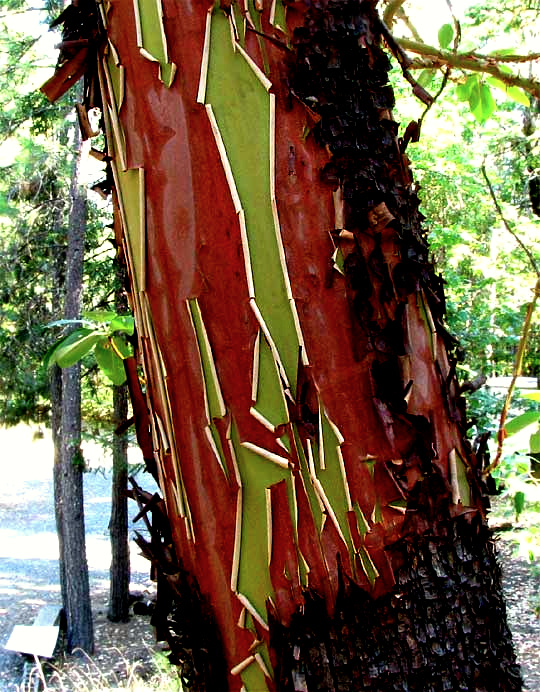
In the afternoon of the second day, we visited a fledgling ethnobotanical garden and did some key-based plant identification. Then we designed an interpretive sign for the plant we identified, listing two traditional native uses of the plant. Our plant was Arbutus menziesii, or Pacific Madrone, with its interesting red (chartreuse when young!) peeling bark and waxy evergreen leaves. It turns out that this plant was used by the Saanich people for making dye, as a remedy for colds and tuberculosis, and as a contraceptive. What a great service learning project this would be for kids! This project could easily highlight the vital role native plants play in the watershed ecosystem, the negative impact of introduced natives (the removal of which would be another great service leaning opportunity), the importance of our native plants to indigenous peoples, to animals, and to us today, and the design of interpretive signs for the garden that reflect their newfound knowledge and enhance the experience of future visitors.
The whole weekend was an amazing opportunity. I am so happy to have been involved. Even though I am not yet teaching, I now have a lot of things in my toolbox that I can draw on and utilize when I’m in the classroom. I think that programs like these are very important for our kids to realize that what we talk about in classrooms is stuff that directly relates to both them as individuals (we all need clean water, for example) and to the world around us. It also gives kids a way to learn experientially, which is such a powerful way to reinforce learning. It also can provide a way for them to help their communities simultaneously. The workshop even addressed ways to make these types of learning experiences a reality in today’s world of budget cuts and cancelled field trips. NOAA provides grants for your classroom! I’m thankful to whoever posted the information about this workshop to our cohort list, though I’ve forgotten who it was!


Wow. Very very cool. And why aren't all kids able to just routinely access these sorts of experiences.
ReplyDeleteI want to encourage you to share as much of this as possible with the cohort -- at this point, it's hard for many of us to imagine what this sort of learning could look like and smell like and feel like... I don't remember who put up the info, either.
A wiki page on science resources??
SO, where is someone with interests like yours going to student teach? Do you know yet?